9 Dog Years in Human Years: What Age Is That?
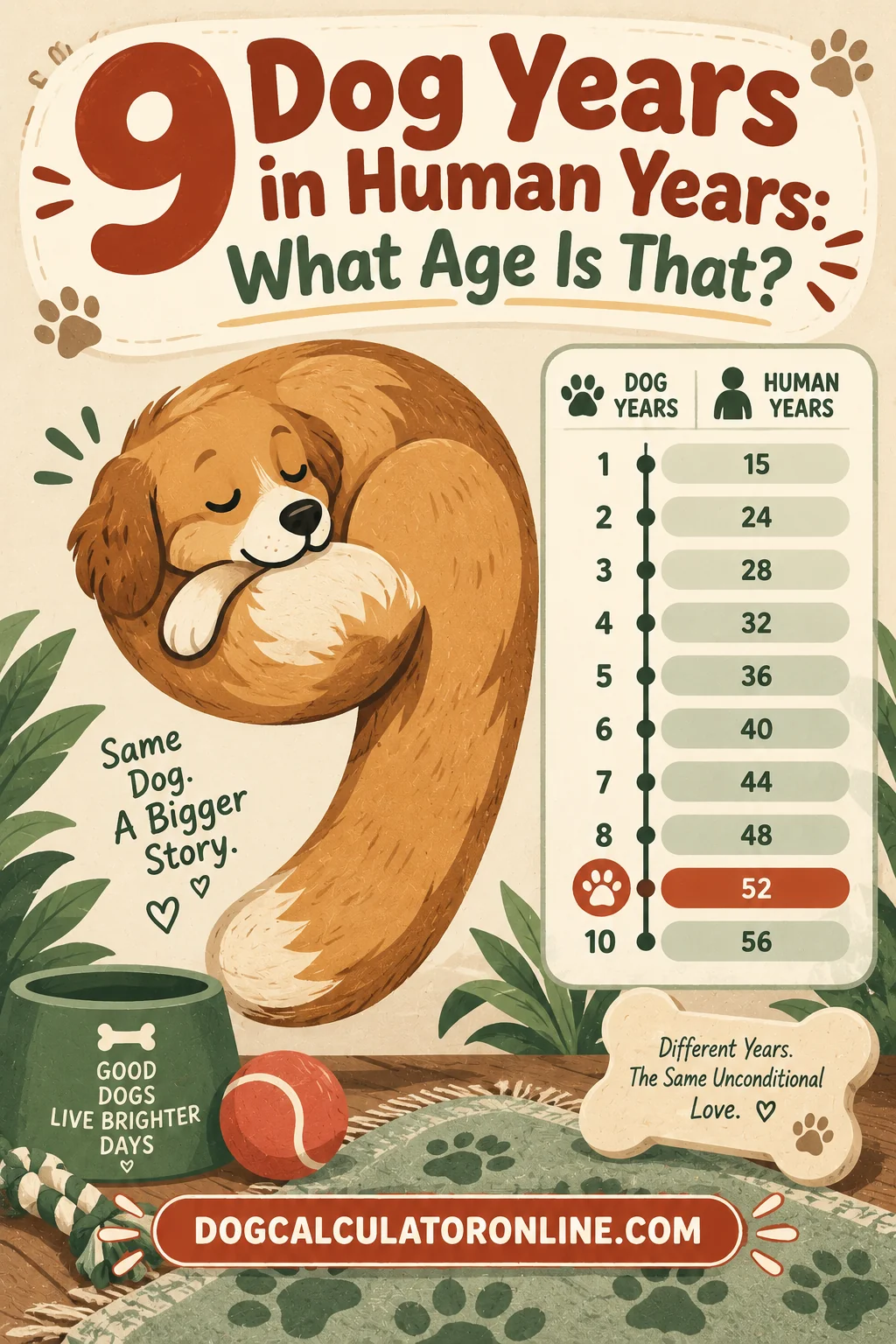
A 9-year-old dog is roughly 52 in human years if she is small, 56 if medium, 61 if large, and about 71 if she is a giant breed. There is no single number, because size drives canine aging more than anything else, and by year nine the gap between a Chihuahua and a Great Dane is already close to twenty human years.
So the honest answer to what 9 in dog years works out to is: it depends on how much your dog weighs. A 9-year-old Chihuahua is a comfortably middle-aged dog with years of normal life ahead. A 9-year-old Great Dane is an old dog, and should be treated like one.
The Answer by Size
| Your dog's size | Adult weight | 9 years is about |
|---|---|---|
| Small | Up to 20 lb | 52 human years |
| Medium | 21-50 lb | 56 human years |
| Large | 51-100 lb | 61 human years |
| Giant | Over 100 lb | 71 human years |
Size class goes by adult weight, and for a mixed breed you use the scale rather than the ancestry panel. A 60-pound mix ages on the large-dog curve no matter what the DNA test says about her background.
If you want the figure for a different age, or for a dog sitting right on a weight boundary, the dog age calculator on this site runs the same size-banded chart and handles half-years, which a table cannot do cleanly.
What Are Dog Years, Really
It is worth being precise about the term, because it gets used two different ways and the confusion causes most of the bad math.
Strictly, what are dog years is a question about a conversion, not a unit of time. A dog year is one calendar year of a dog's life, expressed as the human age at a roughly equivalent life stage. It is a translation, not a measurement. Nobody is claiming a dog experiences a year differently; the claim is that a dog at nine is at a comparable point in her physical arc to a person in their fifties.
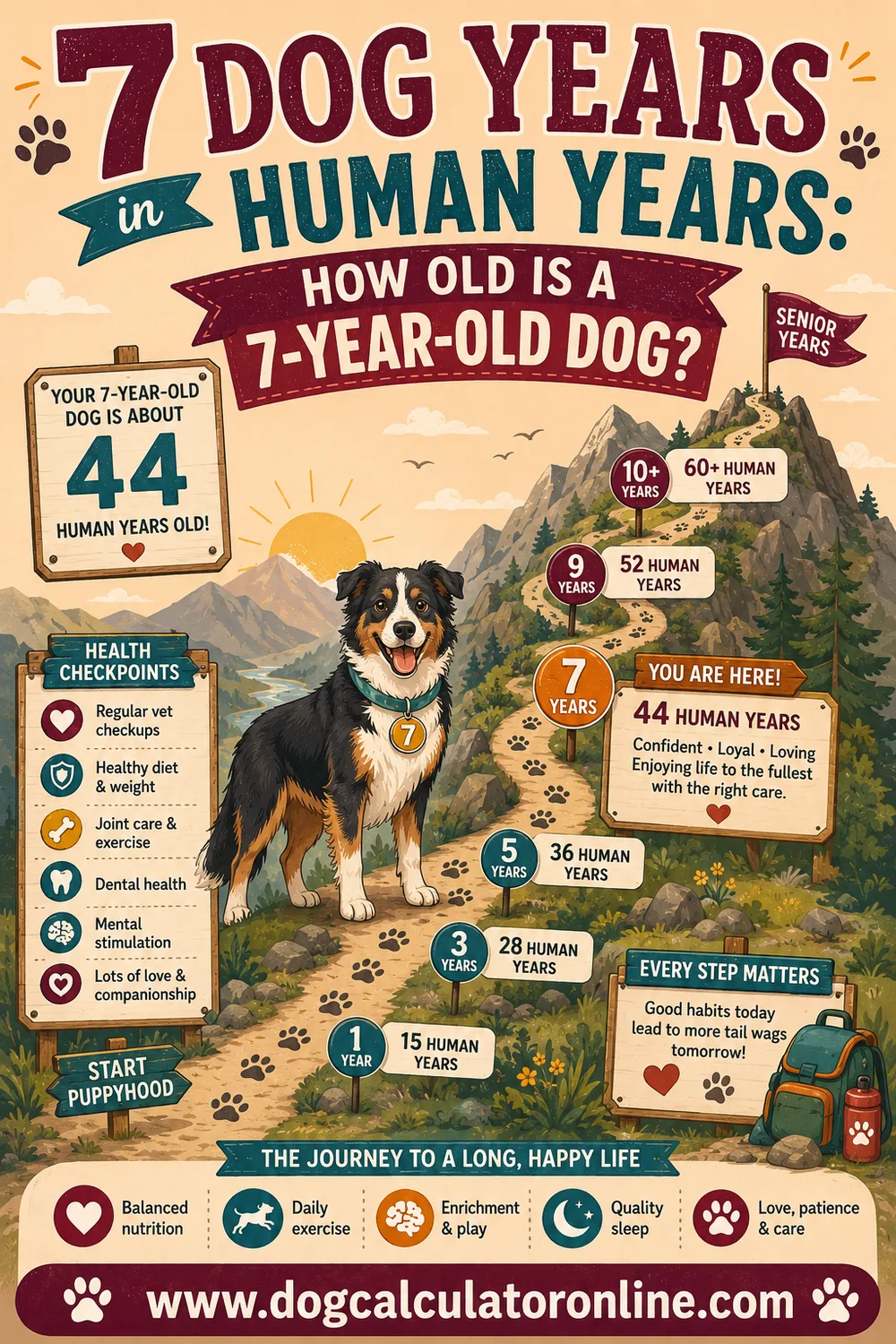
That means the conversion is not a fixed rate. It is steep at the start and flattens out. A dog's first year covers puppyhood, adolescence and full physical maturity, which takes a human about fifteen years. The second year adds roughly nine more. After that the annual increment settles into a much slower and steadier climb, and that is where size starts to matter.
Search boxes fill up with every phrasing of this question, from dog dog years to how many dog years is in a year, and they are all asking the same thing: how many years for a dog counts as one of ours. The answer is that it changes with the dog's age and with her size, which is exactly why the single-multiplier rules never quite work.
Why the Times-Seven Rule Fails
Multiplying by seven gives 63 for a 9-year-old dog of any size. That is far too high for a small dog, roughly right by accident for a large one, and too low for a giant breed. As a rule it is wrong in three different directions at once.
The bigger problem is that it was never based on biology. It appears to come from a rough mid-twentieth-century observation that people lived about 70 years and dogs about 10, and 70 divided by 10 is a memorable number. That is the entire foundation.
Where it fails most obviously is at the young end. Take the question of how many dog years is in a year for a puppy. Times seven says a one-year-old dog is equivalent to a seven-year-old child. But a one-year-old dog has a full set of adult teeth, has reached her adult height, and in many breeds can reproduce. No seven-year-old child is anywhere near that. The realistic equivalent for a one-year-old dog is closer to fifteen.
It fails again at the old end by ignoring size completely. It hands the same number to a 9-year-old Yorkshire Terrier and a 9-year-old Mastiff, when those two dogs are at genuinely different stages of life.
Times seven is not useless as a party fact. It is just not a number to make decisions with, and the difference between 63 and the real 52 for a small dog is the difference between treating a middle-aged dog as a senior and letting her get on with it.
The Full Dog Years Chart
This is the size-banded conversion, with year nine in the middle so you can see what comes before and after.
| Dog's age | Small (≤20 lb) | Medium (21-50 lb) | Large (51-100 lb) | Giant (100+ lb) |
|---|---|---|---|---|
| 1 year | 15 | 15 | 15 | 12 |
| 2 years | 24 | 24 | 24 | 22 |
| 3 years | 28 | 28 | 28 | 31 |
| 4 years | 32 | 32 | 32 | 38 |
| 5 years | 36 | 36 | 36 | 45 |
| 6 years | 40 | 42 | 45 | 49 |
| 7 years | 44 | 47 | 50 | 56 |
| 8 years | 48 | 51 | 55 | 64 |
| 9 years | 52 | 56 | 61 | 71 |
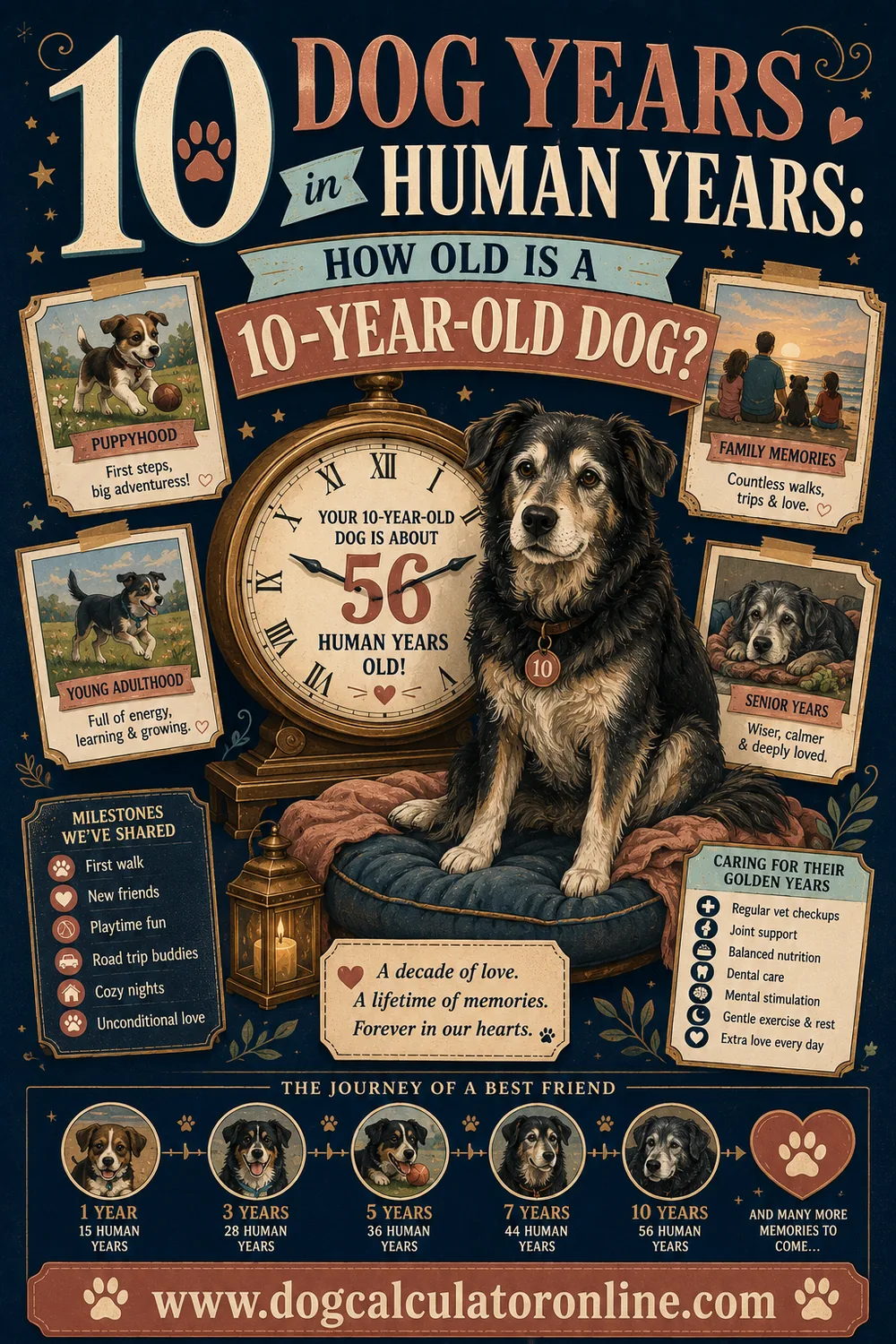
| 10 years | 56 | 60 | 66 | 79 |
| 11 years | 60 | 65 | 72 | 86 |
| 12 years | 64 | 69 | 77 | 93 |
| 13 years | 68 | 74 | 82 | 100 |
| 14 years | 72 | 78 | 88 | 107 |
Three things are worth reading out of that dog years chart.
The first five rows are almost identical across small, medium and large. All three columns run 15, 24, 28, 32, 36. Ask what 4 years in dog years means and the answer is 32 for a small dog, 32 for a medium dog and 32 for a large one. Only the giant column differs, at 38, because giant breeds start aging faster almost immediately.
Year six is the fork. That is where the columns split: 40, 42, 45, 49. Every year after that the spread widens.
By year nine the fan has opened to nineteen years between the smallest and largest dogs, and it keeps opening. By thirteen the same gap is over thirty years.
Why Size Changes Everything
Across the animal kingdom, bigger species generally live longer than smaller ones. Within the dog species the opposite is true, and it is one of the more interesting puzzles in canine biology.
The leading explanation is growth rate. A Great Dane puppy goes from about a pound at birth to well over a hundred pounds in roughly a year. A Chihuahua goes from a few ounces to about five pounds over the same period. That difference in growth involves far more cell division and much higher levels of circulating growth factors in the large dog, and there appears to be a long-term cost to that pace: age-related change arrives earlier and progresses faster.
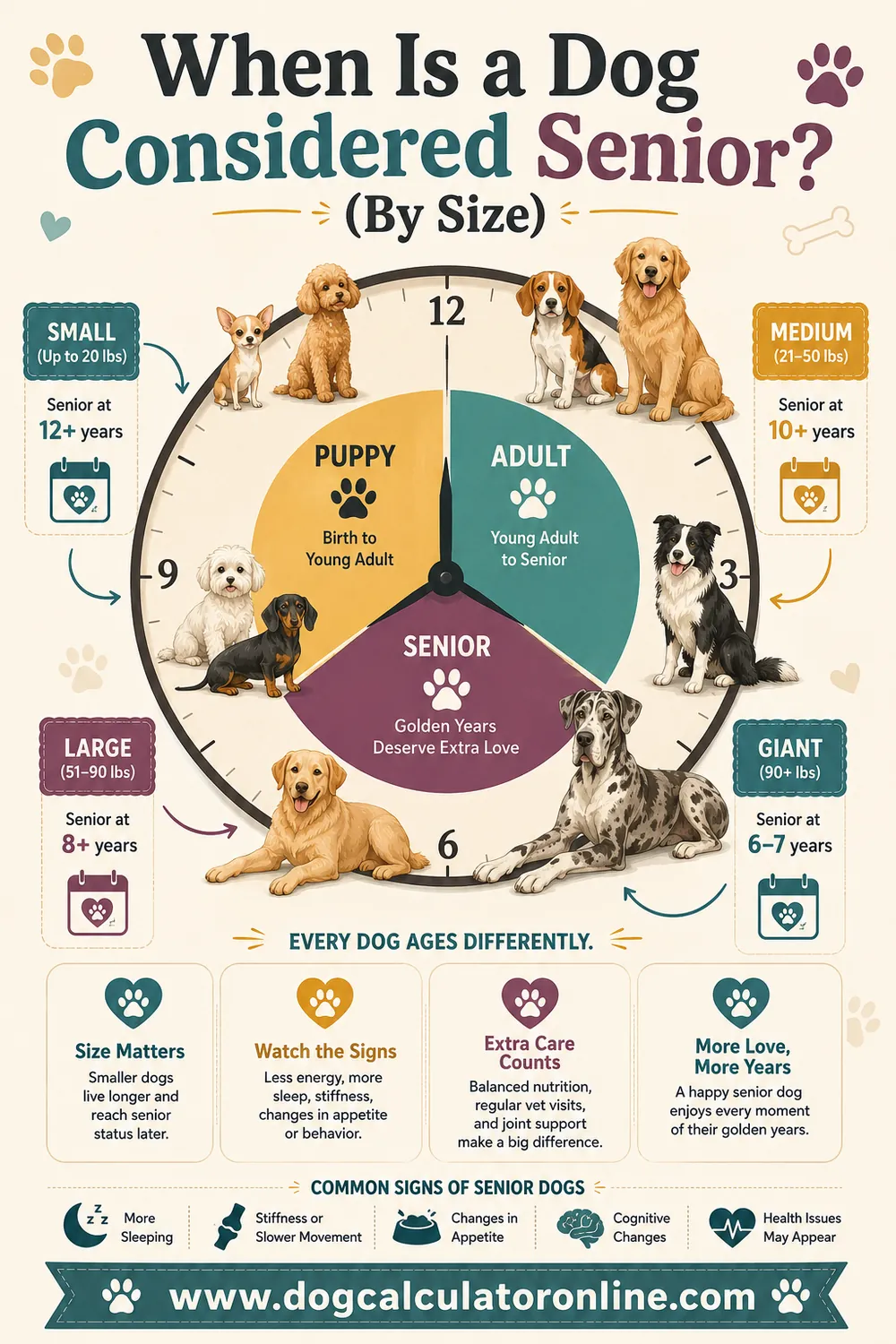
Whatever the exact mechanism, the pattern is consistent enough that veterinarians build their life-stage guidance around body size rather than a single all-breeds timeline. Small dogs are generally considered senior around ten or eleven, large dogs around seven or eight, and giant breeds as early as six.
That is why a dog years calculator that asks for weight gives a more useful answer than one that does not. Any dog years calculator relying on a single multiplier is, by design, wrong for most of the dogs using it.
What 9 Actually Looks Like
The number is a translation. What matters day to day is the life stage, and at nine that stage differs sharply by size.
Small dogs at nine are middle-aged. Think of a person in their early fifties: mostly capable, slightly less spring in the step, and at the age where routine health screening starts to be genuinely worthwhile. Many small dogs at nine behave almost exactly as they did at five.
Medium dogs at nine are late middle age. Slightly longer recovery after a hard run. Perhaps a little more sleep. Nothing dramatic.
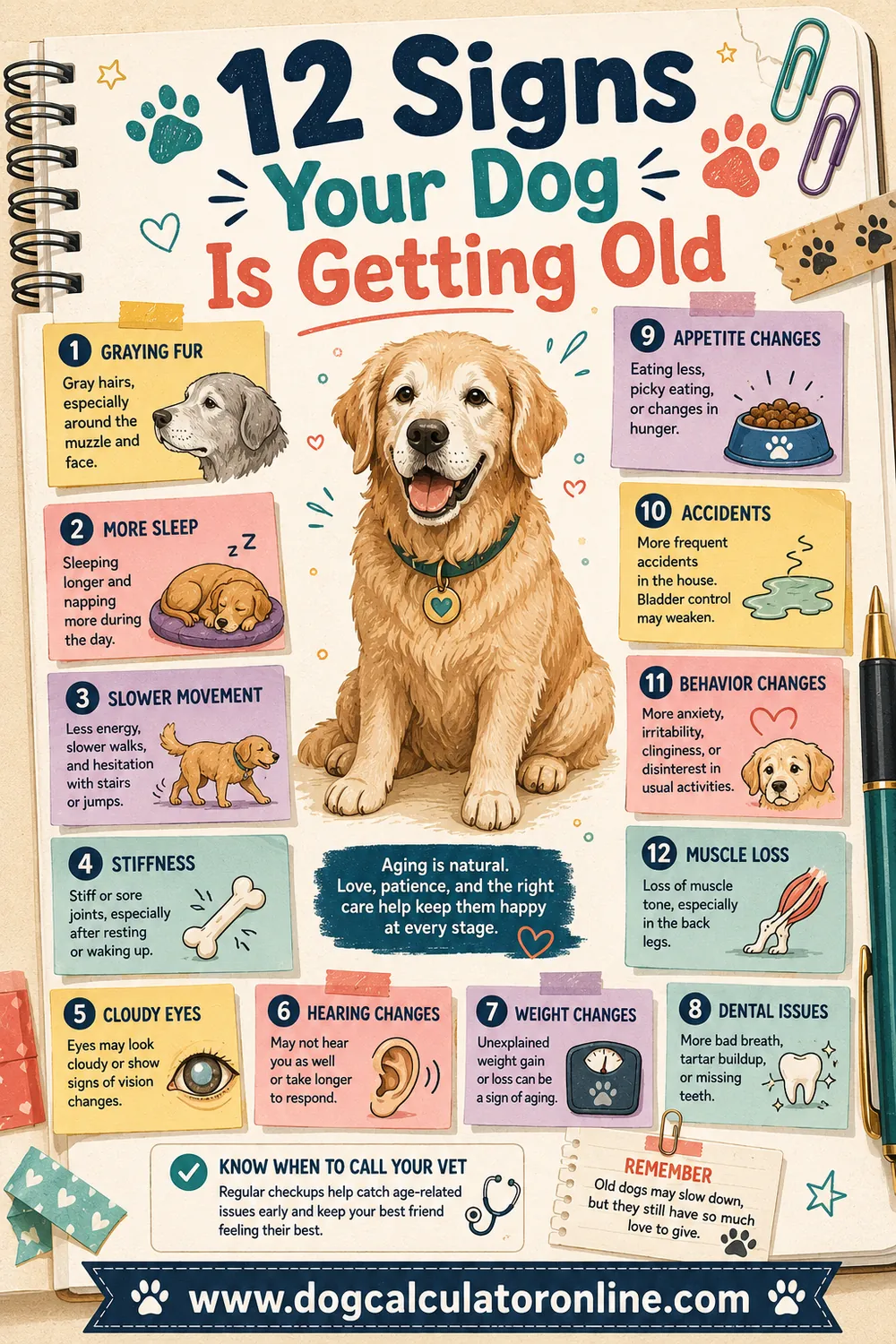
Large dogs at nine are early seniors. Stiffness after a nap, more deliberate approaches to stairs, and the beginning of gray around the muzzle. Exercise usually needs to shift from intensity toward regularity.
Giant breeds at nine are genuinely old. Many giant breeds average seven to ten years of life, so a 9-year-old Great Dane, Saint Bernard or Mastiff has already reached the upper part of a typical span. Comfort, joint support and frequent veterinary attention become the whole agenda.
Across all sizes, some changes are common at nine and are simply aging rather than illness. Sleep expands. Hearing often fades before sight, and it fades gradually enough that owners frequently read it as stubbornness. The eyes may develop a bluish haze in the lens, called lenticular sclerosis, which is a normal hardening, is not painful, and affects vision far less than it appears to. Cataracts are a different thing, denser and whiter, and worth a professional opinion to tell them apart.
Common Breeds at Nine
If weighing your dog is inconvenient, here is where familiar breeds land.
| Breed | Size class | 9 years is about |
|---|---|---|
| Chihuahua | Small | 52 |
| Dachshund | Small | 52 |
| Yorkshire Terrier | Small | 52 |
| Shih Tzu | Small | 52 |
| Pug | Small | 52 |
| Beagle | Medium | 56 |
| Border Collie | Medium | 56 |
| Cocker Spaniel | Medium | 56 |
| French Bulldog | Medium | 56 |
| Australian Shepherd | Medium | 56 |
| Labrador Retriever | Large | 61 |
| Golden Retriever | Large | 61 |
| German Shepherd | Large | 61 |
| Boxer | Large | 61 |
| Doberman | Large | 61 |
| Great Dane | Giant | 71 |
| Saint Bernard | Giant | 71 |
| Newfoundland | Giant | 71 |
| Mastiff | Giant | 71 |
Breed is a shortcut for weight here, not an independent factor. Two Labradors at very different body weights will age slightly differently, and a mixed breed goes by the scale.
Care Priorities for a 9-Year-Old Dog
Nine is the age where a few changes are worth making before anything is obviously wrong.
Start annual bloodwork, or move to twice-yearly checkups for a large or giant dog. The conditions that matter most at this stage, including kidney disease, liver changes, thyroid problems and diabetes, show up in lab work long before they show up in behavior. For a giant breed at nine, twice-yearly visits are the standard advice.
Adjust the food to the activity. Most dogs slow down slightly around this age while their portion stays the same, and the result is gradual weight gain. Extra weight on aging joints is the most direct thing you can fix at home. Being able to feel the ribs easily without pressing hard is the usual guide.
Take stiffness seriously rather than accepting it. Osteoarthritis is common and badly under-treated in dogs, largely because they hide pain well and owners read slowing down as inevitable. It is treatable. One critical warning: human pain relievers are dangerous to dogs, and ibuprofen, acetaminophen, naproxen and aspirin can all cause serious harm. Any pain management goes through a veterinarian.
Keep her moving, and make it regular rather than intense. Muscle loss accelerates quickly without use, and weaker muscles mean less joint support. Two shorter walks beat one long one, and swimming is excellent for a dog with sore joints.
Deal with teeth. Dental disease is close to universal by this age and is not confined to the mouth, since chronic oral infection puts real strain on the rest of the body. Breath that has gotten noticeably worse, chewing on one side, or dropping food are all worth mentioning.
Give the brain work. Puzzle feeders, short training sessions with cues she already knows, and walks that let her sniff at her own pace all matter more as dogs age.
Signs Worth a Call Rather Than a Wait
Aging is gradual. These are not, and at nine they are worth a prompt call rather than another week of watching:
- A noticeable change in drinking or urinating
- Weight loss without a diet change
- A new cough or labored breathing
- A lump that is new, growing, or changing
- Sudden reluctance to use the back legs, or a change in gait
- Appetite loss lasting more than a day or two
- Any collapse, disorientation, or seizure
None of these necessarily mean something serious. All of them mean the question is better answered by a veterinarian than by a chart.
Is Nine Old for a Dog?
For a small dog, no. Nine is comfortably middle-aged, and small breeds frequently live to fifteen or sixteen. There is a lot of life left.
For a medium dog, nine is late middle age. Still active, still capable, just at the point where a yearly blood panel earns its place.
For a large dog, nine is the beginning of the senior years. Many large breeds average ten to twelve years, so a 9-year-old Labrador is entering the last stretch rather than the middle of the story.
For a giant breed, nine is already old and worth appreciating. A 9-year-old Great Dane has outlived a good many of her breed, and the priorities shift entirely toward comfort.
Whatever the size, the useful reframe at nine is not counting down. It is noticing sooner: more frequent checkups, faster responses to small changes, and a bit more attention paid to joints, weight and teeth. Most of what makes a dog's later years good is unglamorous, and almost all of it starts working better when you begin at nine rather than at twelve.
Frequently Asked Questions
How old is a 9-year-old dog in human years? About 52 for a small dog, 56 for a medium dog, 61 for a large dog and 71 for a giant breed. The old times-seven rule would say 63 for all of them, which is too high for small dogs and too low for giant ones.
Is a 9-year-old dog considered a senior? It depends on size. Small dogs usually reach senior status around ten or eleven, large dogs around seven or eight, and giant breeds as early as six. So a 9-year-old Chihuahua is middle-aged while a 9-year-old Great Dane is well into her senior years.
Why do big dogs age faster than small ones? The leading explanation is growth rate. Giant breeds gain more than a hundred pounds in their first year, which involves far more cell division and much higher levels of growth factors than a small dog experiences, and that pace appears to come with an earlier onset of age-related change.
Should a 9-year-old dog still exercise? Yes, regularly rather than intensely. Muscle loss speeds up quickly without use and weaker muscles give aching joints less support, so two shorter walks a day generally beat one long one, and swimming is ideal for a dog who enjoys it.