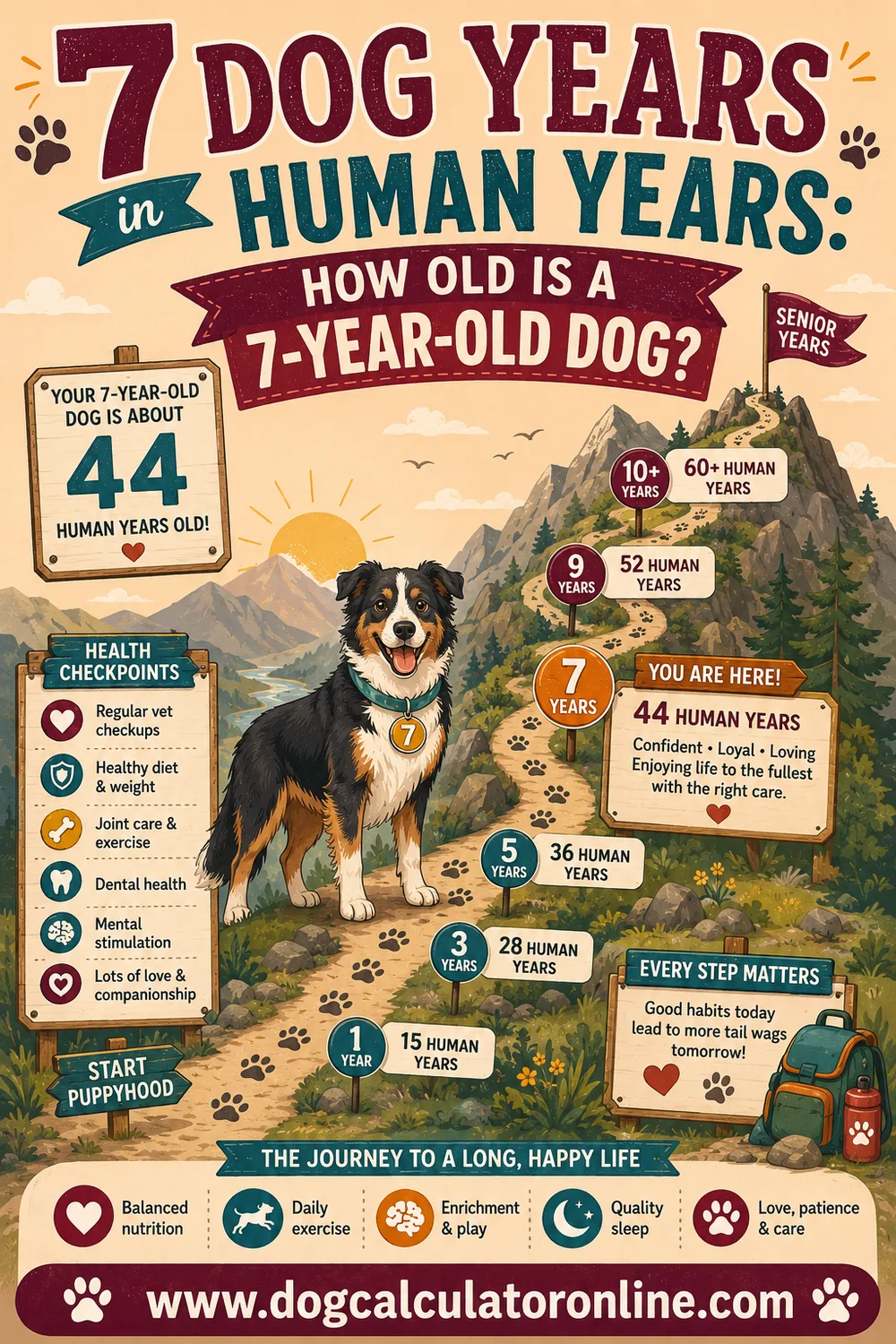
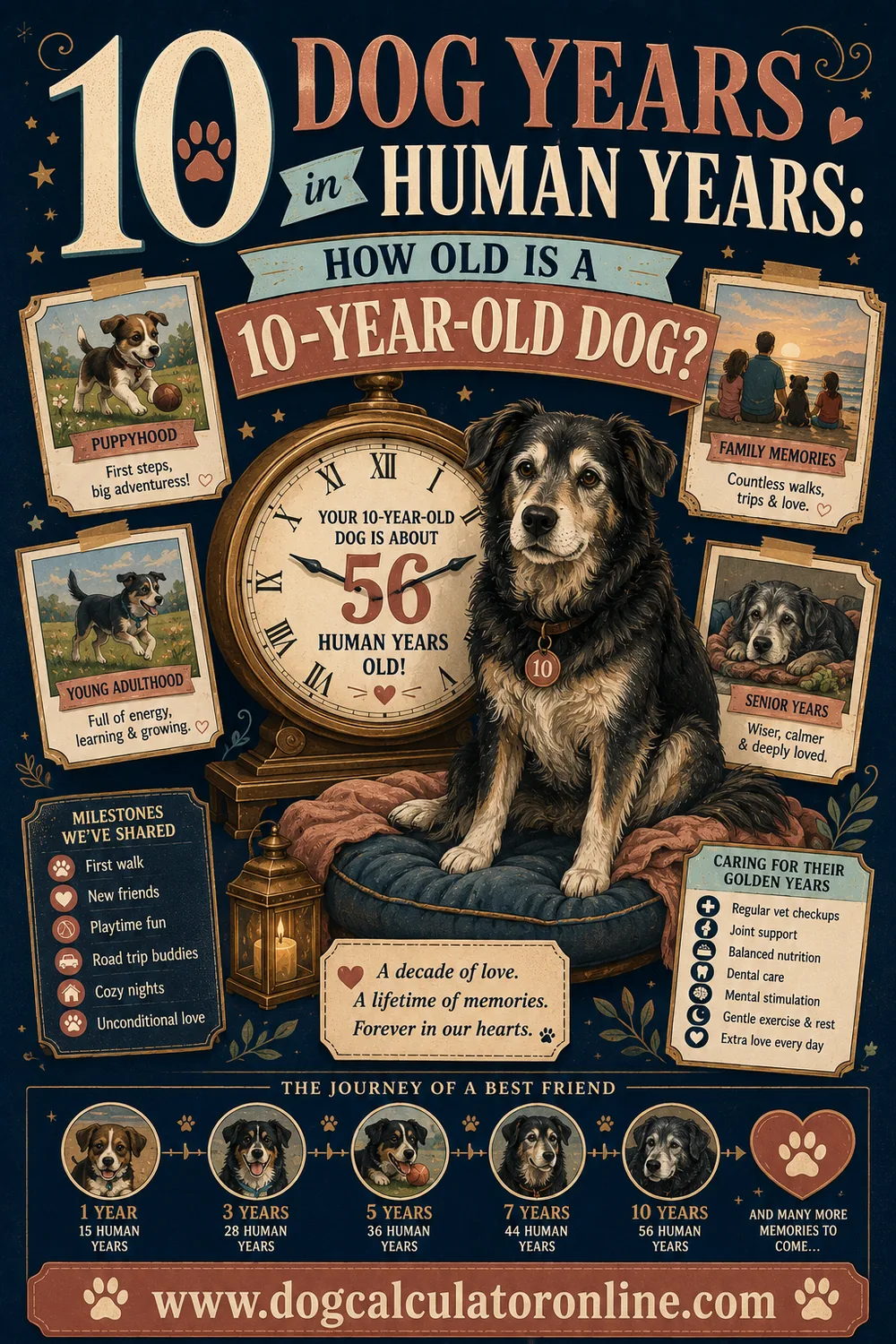
6 Dog Years in Human Years: What Age Is Your Dog Really?
A 6-year-old dog is about 40 in human years if she is small, 42 if medium, 45 if large, and roughly 49 if she is a giant breed. Six is the year those four numbers stop matching, and that makes it the most important single row on the whole conversion chart.
For the first five years of life, small, medium and large dogs age at the same rate. The columns run 15, 24, 28, 32, 36 with no adjustment at all. Year six is the fork in the road. From here on, every additional year costs a big dog more than it costs a small one, and the gap never closes again.
The Quick Answer by Size
| Your dog's size | Adult weight | 6 years is about |
|---|---|---|
| Small | Up to 20 lb | 40 human years |
| Medium | 21-50 lb | 42 human years |
| Large | 51-100 lb | 45 human years |
| Giant | Over 100 lb | 49 human years |
Size class goes by adult weight, and at six that is simply what your dog weighs today. For a mixed breed, use the scale rather than the ancestry panel. A 60-pound mix ages on the large-dog curve no matter what her DNA report says.
If you want the figure for a different age, or for a dog sitting right on a weight boundary, the dog age calculator on this site runs the same size-banded chart.
Year Six Is the Fork in the Road
This is the single most useful thing on this page. Look at the conversion chart as a whole and it has two distinct halves, and the seam between them is year six.
Before six, the small, medium and large columns are identical. Ask what 4 in dog years works out to and the answer is 32, 32 and 32. Ask about five and it is 36, 36 and 36. There is nothing to decide, because the size of your dog does not yet change the answer.
At six, the columns split for the first time: 40, 42, 45 and 49. So the honest answer to what 6 in dog years works out to is: for the first time in your dog's life, it depends on how much she weighs. The spread is only nine years wide at this point, which does not look like much. What matters is the slope. From year six onward the per-year increment is different for each size class:
- A small dog picks up about 4 human years per calendar year
- A medium dog picks up about 4 to 5
- A large dog picks up about 5 to 6
- A giant breed picks up about 7
Run those forward and the fan opens fast. By nine the spread is nineteen years. By thirteen it is thirty-two. By sixteen the small column reads 80 and the giant column reads 121. All of that divergence traces back to the branch point at year six.
There is a second reason six matters, and it is more practical than arithmetic. Six is the age at which the size classes stop needing the same care. A 6-year-old Chihuahua is a healthy adult with most of her life ahead. A 6-year-old Great Dane is entering her senior years and should be treated like a senior dog, with twice-yearly checkups and real attention to joints. Those two dogs share a birthday and almost nothing else.
The Full Conversion Chart
Year six sits in the middle here so you can see the flat stretch behind it and the fan in front of it.
| Dog's age | Small (≤20 lb) | Medium (21-50 lb) | Large (51-100 lb) | Giant (100+ lb) |
|---|---|---|---|---|
| 1 year | 15 | 15 | 15 | 12 |
| 2 years | 24 | 24 | 24 | 22 |
| 3 years | 28 | 28 | 28 | 31 |
| 4 years | 32 | 32 | 32 | 38 |
| 5 years | 36 | 36 | 36 | 45 |
| 6 years | 40 | 42 | 45 | 49 |
| 7 years | 44 | 47 | 50 | 56 |
| 8 years | 48 | 51 | 55 | 64 |
| 9 years | 52 | 56 | 61 | 71 |
| 10 years | 56 | 60 | 66 | 79 |
| 11 years | 60 | 65 | 72 | 86 |
| 12 years | 64 | 69 | 77 | 93 |
| 13 years | 68 | 74 | 82 | 100 |
The giant column is the odd one out from the very start. It reads 12 at year one, because a giant puppy is still physically finishing at twelve months while a small dog is done growing. Then it climbs past everyone by year three and never gives the lead back.
Why Size Changes Everything After Six
Across the animal kingdom, larger species generally live longer than smaller ones. Within the dog species the opposite holds, and it is one of the more interesting puzzles in canine biology.
The leading explanation is growth rate. A Great Dane puppy goes from roughly a pound at birth to well over a hundred pounds in about a year. A Chihuahua goes from a few ounces to about five pounds in the same period. The large dog's growth involves vastly more cell division and much higher levels of circulating growth factors, and there appears to be a long-term cost to that pace. Age-related change arrives earlier and moves faster.
What that theory explains neatly is exactly the pattern on the chart. Growth itself takes about the same length of time in every dog, which is why the first five years match. The cost of that growth shows up later, which is why the columns separate afterward rather than at the beginning.
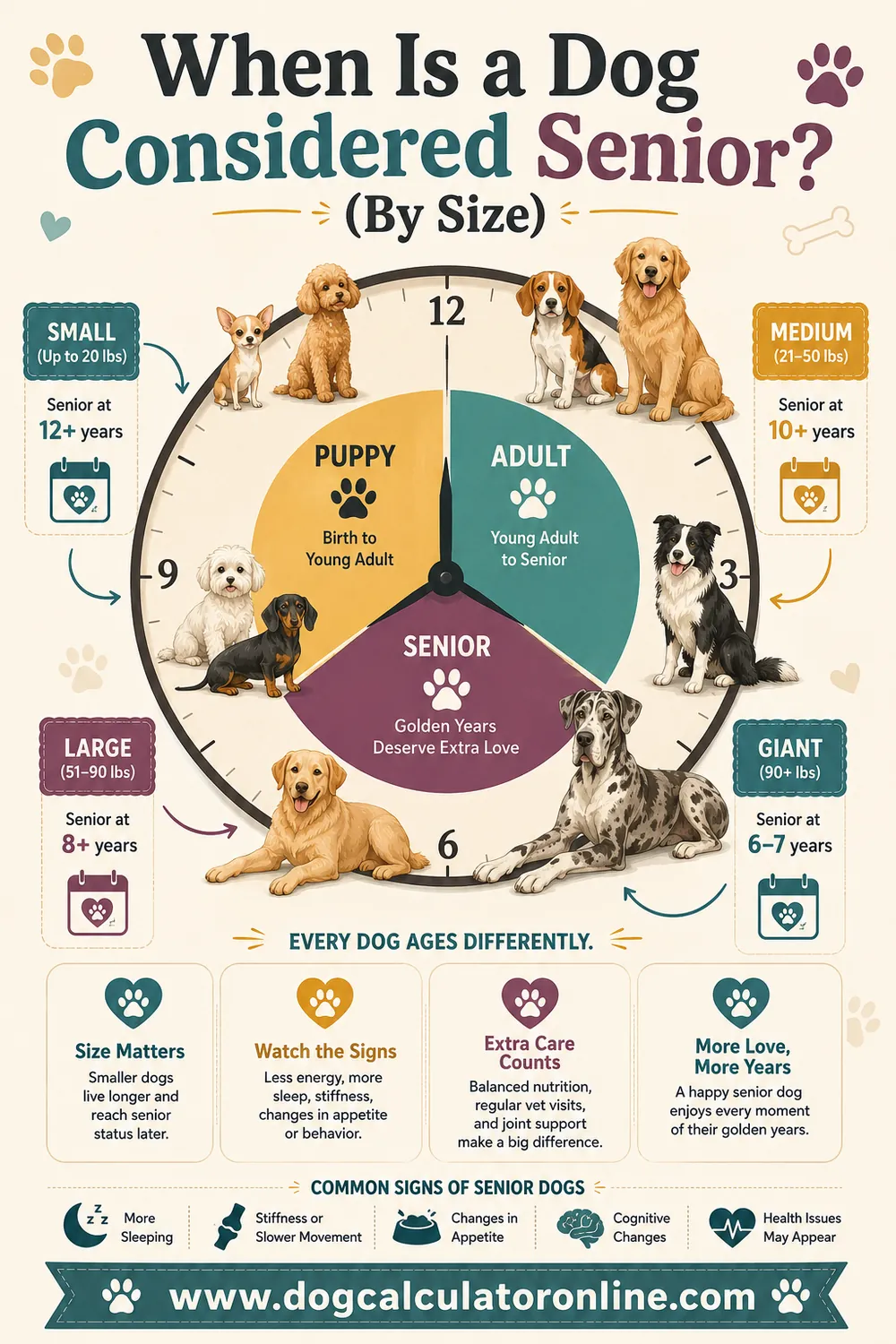
Whatever the precise mechanism, the pattern is consistent enough that veterinarians set life-stage guidance by body size rather than one all-breeds timeline. Small dogs are generally considered senior around ten or eleven, large dogs around seven or eight, and giant breeds as early as six.
That last figure is worth reading twice. For a giant breed, six is not the fork in the road so much as the arrival of the senior stage itself.
Forget the Seven-Year Rule
Multiplying by seven gives 42 for a 6-year-old dog of any size. By coincidence that is exactly right for a medium dog and only mildly wrong for the others, which is a large part of why the rule refuses to die. It gets close enough often enough in the middle of a dog's life that nobody notices how badly it fails at the ends.
The rule was never derived from biology. It appears to come from a rough mid-twentieth-century observation that people lived about 70 years and dogs about 10. That is the whole basis.
It fails most obviously with puppies. Times seven says a one-year-old dog is equivalent to a seven-year-old child, but a one-year-old dog has adult teeth, adult height and, in most breeds, the ability to reproduce. The realistic equivalent is nearer fifteen.
It fails again at the senior end by ignoring size, handing the same number to a 13-year-old Yorkshire Terrier and a 13-year-old Mastiff when the two are in genuinely different chapters of life.
Six is precisely the age at which the times-seven rule stops being harmless. Before six the size classes agree with each other, so a single multiplier is only mildly wrong. After six the classes diverge, and one number for all dogs starts producing real mistakes, most commonly treating a large or giant dog as middle-aged when she has already entered her senior years.
What 6 Actually Looks Like, by Size
The number is a translation. The life stage is what you actually live with, and at six the stage is different depending on what your dog weighs.
Small dogs at six are solidly adult. Think of a person around forty. Energy is close to what it was at three, recovery after a long day is still quick, and nothing much has started to fade. Many small dogs at six behave essentially as they did at four.
Medium dogs at six are adult, with the first small hints. A slightly longer nap after a hard hike. Perhaps a few gray hairs starting at the muzzle. Nothing that changes the routine.
Large dogs at six are on the edge of the senior stage. This is where stiffness after a nap starts to be worth noticing rather than dismissing, where the muzzle begins to gray in earnest, and where exercise should start shifting from intensity toward regularity. A 6-year-old Labrador or German Shepherd is not old, but she is closer to it than her owner usually thinks.
Giant breeds at six are seniors. Many giant breeds average seven to ten years of life, so six puts a Great Dane, Mastiff or Saint Bernard well into the later part of her span. Twice-yearly veterinary visits, serious attention to joints and careful weight management are all standard advice at this age for a giant dog.
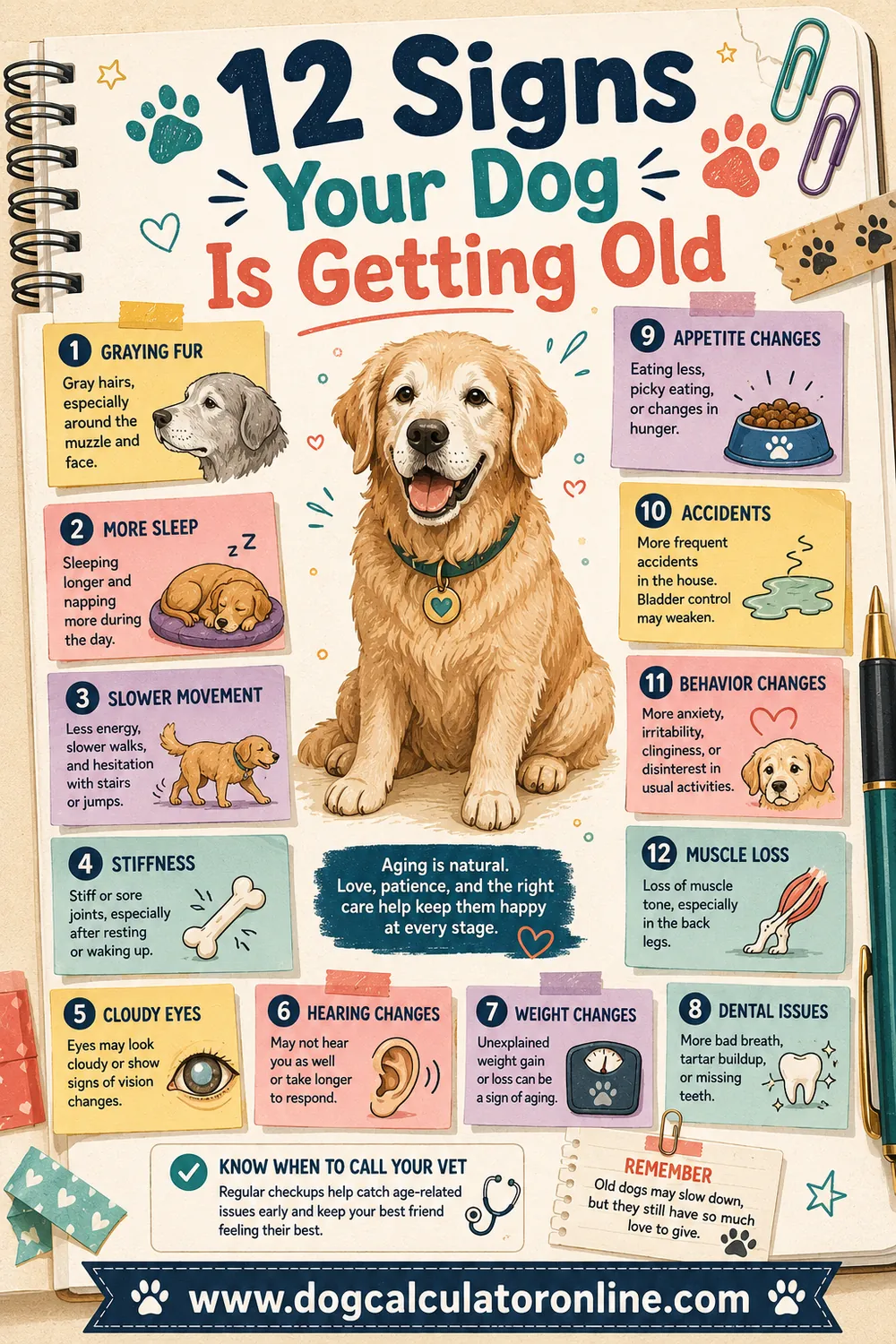
Across every size, a few changes are common at six and are aging rather than illness. Sleep expands slightly. Recovery takes a little longer. Some dogs get calmer and easier to live with, which owners often enjoy and occasionally misread as low energy.
6 Years Old, Broken Out by Breed
If weighing your dog is inconvenient, here is where familiar breeds land at six. This is the first age on the chart where the breed genuinely changes the answer.
| Breed | Size class | 6 years is about |
|---|---|---|
| Chihuahua | Small | 40 |
| Dachshund | Small | 40 |
| Yorkshire Terrier | Small | 40 |
| Shih Tzu | Small | 40 |
| Pug | Small | 40 |
| Beagle | Medium | 42 |
| Border Collie | Medium | 42 |
| Cocker Spaniel | Medium | 42 |
| French Bulldog | Medium | 42 |
| Australian Shepherd | Medium | 42 |
| Labrador Retriever | Large | 45 |
| Golden Retriever | Large | 45 |
| German Shepherd | Large | 45 |
| Boxer | Large | 45 |
| Doberman | Large | 45 |
| Great Dane | Giant | 49 |
| Saint Bernard | Giant | 49 |
| Newfoundland | Giant | 49 |
| Mastiff | Giant | 49 |
Breed is a shortcut for weight, not an independent factor. Two Labradors at very different body weights will age slightly differently, and a mixed breed goes by the scale.
Care Priorities for a 6-Year-Old Dog
Because six is the branch point on the chart, it is also the age where care should stop being one-size-fits-all.
Match the checkup schedule to the size class. An annual exam is generally fine for a small or medium dog at six. For a large dog, this is the year to ask your vet whether twice-yearly visits make sense. For a giant breed, twice-yearly is the standard recommendation, usually with bloodwork, because conditions like kidney disease, liver changes, thyroid problems and diabetes show up in lab work long before they show up in behavior.
Get a baseline blood panel if you have not. Results from a healthy 6-year-old are worth far more than a first panel taken at eleven, because they tell your vet what normal looks like for this particular dog rather than for dogs in general.
Treat creeping weight gain as the priority it is. Activity usually drops slightly after five while the food portion stays the same, and the result is gradual gain that nobody notices month to month. Extra weight on aging joints is the most direct thing you can fix at home. Feeling the ribs easily without pressing hard is the usual guide, along with a visible waist viewed from above.
Take stiffness seriously instead of accepting it. Osteoarthritis is common and badly under-treated in dogs, largely because they hide pain well and owners read slowing down as inevitable. It is treatable, and treatment works better when it starts early. One critical warning: human pain relievers are dangerous to dogs, and ibuprofen, acetaminophen, naproxen and aspirin can all cause serious harm. Any pain management goes through a veterinarian.
Shift exercise toward regular rather than intense, especially for large dogs. Muscle loss accelerates quickly without use, and weaker muscles mean less support for joints. Two shorter walks generally beat one long one, and swimming is excellent for any dog with the beginnings of soreness.
Deal with teeth now. Dental disease is common by six and progresses quietly. Chronic oral infection is not confined to the mouth and puts real strain on the rest of the body. Breath that has gotten noticeably worse, chewing on one side, or dropping food are all worth mentioning at the next visit.
Keep the brain working. Puzzle feeders, short sessions with familiar cues, and walks that let her sniff at her own pace all matter more as dogs age, and habits established at six carry forward well.
Is 6 Old for a Dog?
It depends entirely on size, and six is the first age where that answer is genuinely different from one dog to the next.
For a small dog, six is middle age at most. Small breeds frequently reach fifteen or sixteen, so a 6-year-old Dachshund is barely past the midpoint with years of ordinary life ahead.
For a medium dog, six is comfortably middle-aged and unremarkable.
For a large dog, six is late middle age and the doorstep of the senior years. Many large breeds average ten to twelve years, which puts six past the halfway mark.
For a giant breed, six is already senior. Nothing about that is cause for alarm, but it does change the agenda toward comfort, joint support and closer veterinary attention.
The reframe that makes six useful is this: it is the last year when a single answer covers every dog, and the first year when the care should be tailored. If you want to see where the curve goes next, the 9 dog years and 11 dog years pages pick up the same chart further along.
Frequently Asked Questions
How old is a 6-year-old dog in human years? About 40 for a small dog, 42 for a medium dog, 45 for a large dog, and roughly 49 for a giant breed. Six is the first year on the chart where those four numbers differ from one another.
Why do the numbers split at year six? Because dogs of every size mature at broadly the same rate for the first five years, so their columns are identical through year five. What differs between sizes is when age-related decline begins, and for larger dogs it begins around year six. From that point on, each extra calendar year costs a big dog more human years than it costs a small one.
Is a 6-year-old dog a senior? For a giant breed, yes. For a large dog, six sits right on the edge, and many vets start senior screening around seven or eight. For small and medium dogs, no, since they typically reach senior status closer to ten or eleven.
Should anything change in my dog's care at six? The main change is that care should now depend on size. Large and giant dogs benefit from more frequent checkups and a shift toward regular, moderate exercise, while small and medium dogs can mostly continue as they are with an annual exam. Your vet can tell you which schedule fits your specific dog.