4 Dog Years in Human Years: What Age Is Your Dog Really?
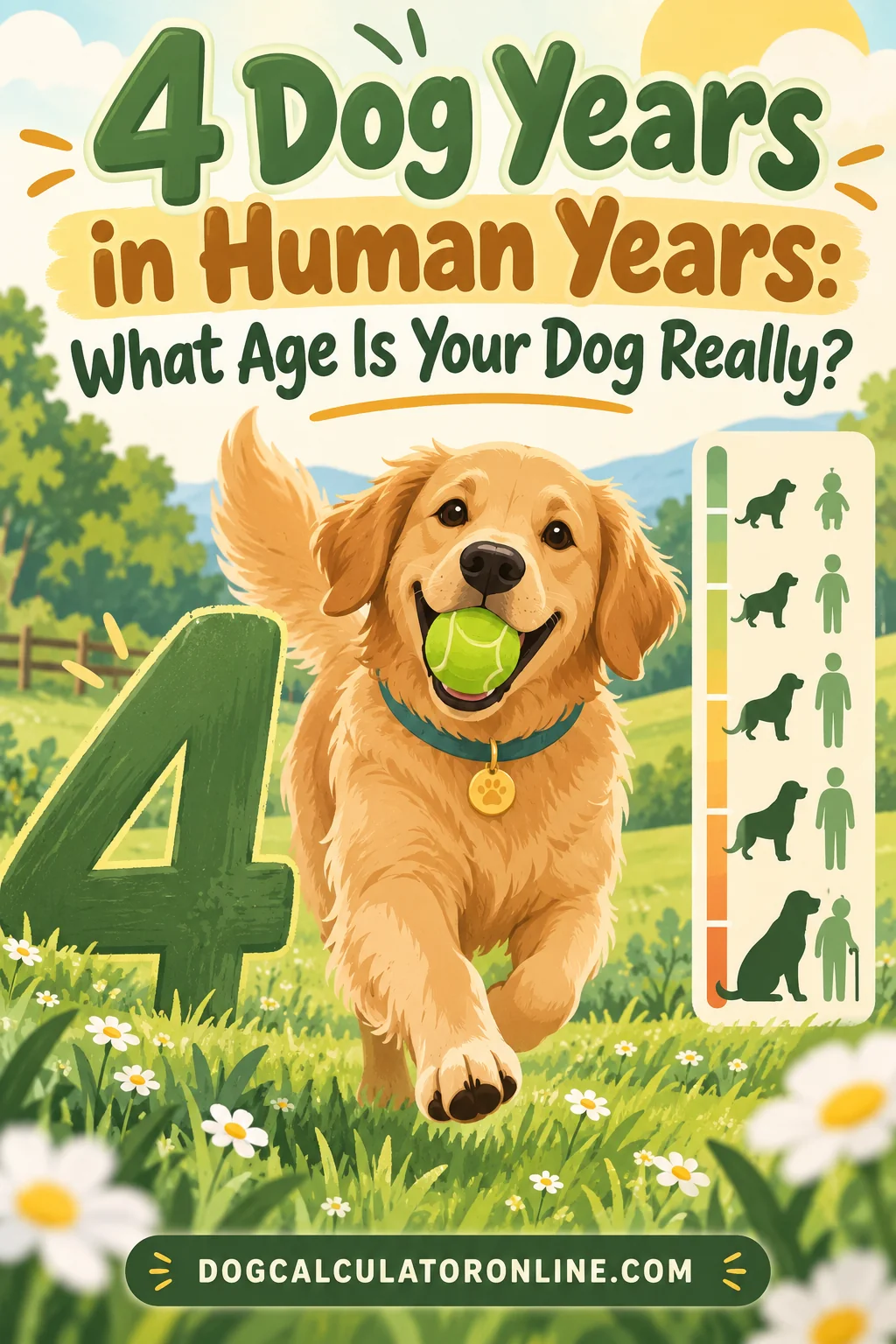
A 4-year-old dog is about 32 in human years, and unusually, that same figure applies whether she is small, medium or large. Only giant breeds differ, landing at roughly 38. Four is one of the few ages where the size question barely matters, which makes it one of the easiest ages to answer honestly.
That is worth pausing on, because almost every other page on this site has to hedge with four different numbers. At four, a Chihuahua, a Beagle and a Labrador are all sitting at roughly the same point in their physical arc. The fanning out that dominates the back half of a dog's life has not started yet.
The Quick Answer by Size
| Your dog's size | Adult weight | 4 years is about |
|---|---|---|
| Small | Up to 20 lb | 32 human years |
| Medium | 21-50 lb | 32 human years |
| Large | 51-100 lb | 32 human years |
| Giant | Over 100 lb | 38 human years |
Size class goes by adult weight, and at four your dog has been at her adult weight for years, so the number on the scale is the number you use. For a mixed breed, use the scale rather than the ancestry panel. A 60-pound mix ages on the large-dog curve regardless of what the DNA test says about her background.
If you want the figure for a different age, or for a dog sitting right on a weight boundary, the dog age calculator on this site runs the same size-banded chart.
Why 4 in Dog Years Is the Same for Three Size Classes
This is the genuinely interesting fact about year four, and it surprises most people who look at a conversion chart for the first time.
Small, medium and large dogs age at effectively identical rates for the first five years of life. The columns run in lockstep: 15, 24, 28, 32, 36. A one-year-old dog is roughly fifteen whatever she weighs. A two-year-old is about twenty-four. And 4 in dog years works out to 32 across all three of those classes, with no adjustment at all.
The split does not arrive until year six, where the columns finally diverge to 40, 42, 45 and 49. From then on the gap widens every single year, until by thirteen there is a thirty-year spread between the smallest dogs and the largest.
The reason for the flat early stretch is that the differences in canine aging are mostly differences in when age-related decline begins, not differences in how fast a dog matures. Every dog, from a Yorkshire Terrier to a Great Dane, goes from newborn to sexually mature in roughly a year and reaches full skeletal maturity somewhere between one and two. Large breeds take a few months longer to finish growing, but the whole process is compressed into the same rough window. What differs is what happens afterward, and afterward starts around year six.
Giant breeds are the exception, and they are the exception from the very beginning. Their column reads 12 at year one, 22 at year two, then 31, 38 and 45. They start slightly behind, because a giant puppy is still physically finishing at twelve months while a small dog is done, and then they overtake everyone by year three and never look back.
The Full Conversion Chart
Here is the size-banded conversion with year four in the middle, so you can see the flat stretch and the point where it ends.
| Dog's age | Small (≤20 lb) | Medium (21-50 lb) | Large (51-100 lb) | Giant (100+ lb) |
|---|---|---|---|---|
| 1 year | 15 | 15 | 15 | 12 |
| 2 years | 24 | 24 | 24 | 22 |
| 3 years | 28 | 28 | 28 | 31 |
| 4 years | 32 | 32 | 32 | 38 |
| 5 years | 36 | 36 | 36 | 45 |
| 6 years | 40 | 42 | 45 | 49 |
| 7 years | 44 | 47 | 50 | 56 |
| 8 years | 48 | 51 | 55 | 64 |
| 9 years | 52 | 56 | 61 | 71 |
| 10 years | 56 | 60 | 66 | 79 |
| 11 years | 60 | 65 | 72 | 86 |
| 12 years | 64 | 69 | 77 | 93 |
Read down the first three columns and the pattern is obvious. Four rows of identical numbers, then a fork, then a widening fan. Year four sits comfortably inside the identical stretch, which is why it is the simplest age on the whole chart to answer.
Forget the Seven-Year Rule
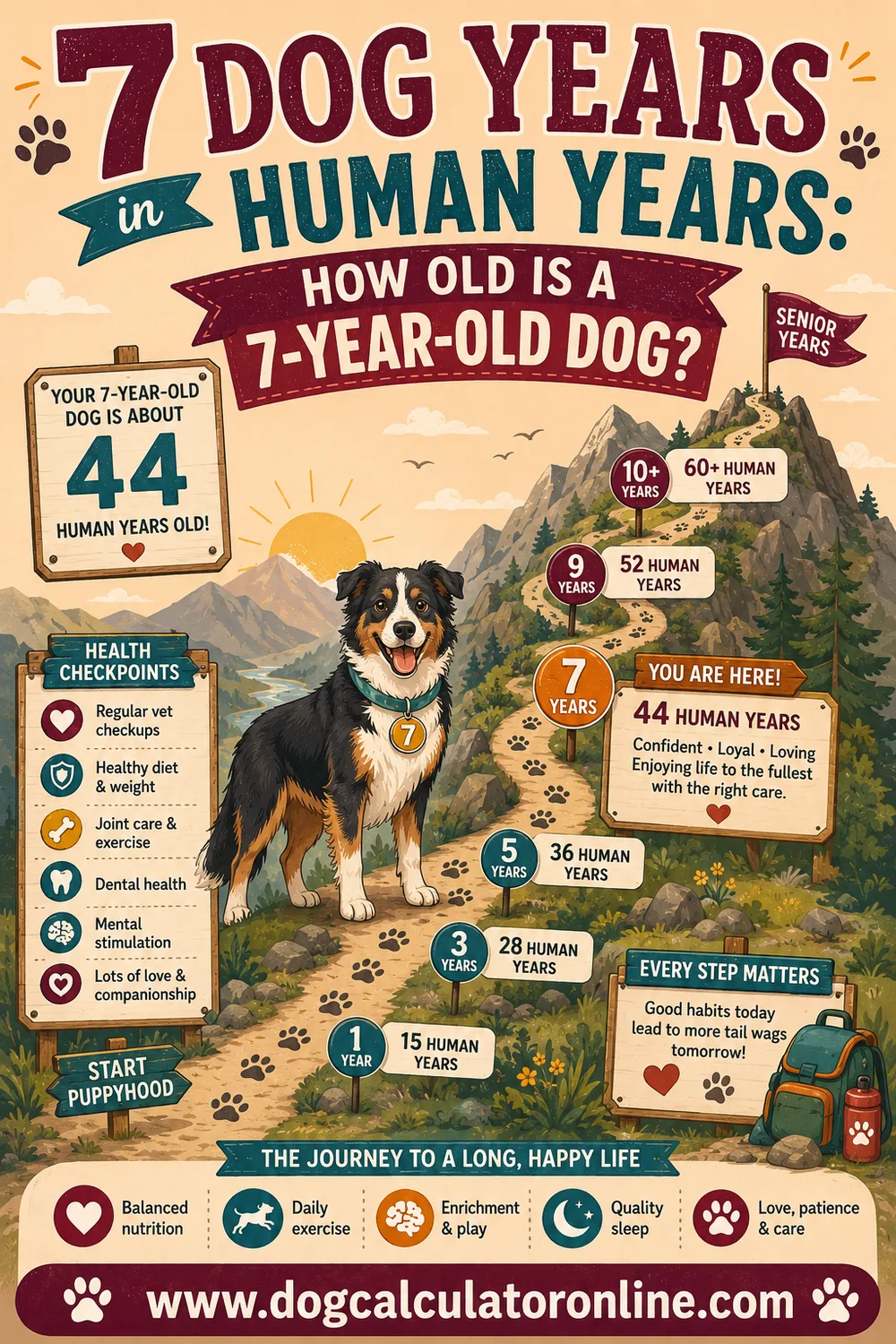
Multiplying by seven gives 28 for a 4-year-old dog. That is not wildly off for once, which is exactly why the rule survives. It happens to land near the truth in the narrow band between roughly three and five years old, and people remember the times it worked rather than the many times it did not.
The rule was never based on biology. It appears to come from a rough mid-twentieth-century observation that people lived about 70 years and dogs about 10, and 70 divided by 10 is a memorable number. That is the entire foundation.
It breaks most obviously at the young end. Times seven says a one-year-old dog is equivalent to a seven-year-old child, but a one-year-old dog has a full set of adult teeth, has reached her adult height, and in most breeds can reproduce. No seven-year-old child is anywhere close to that. The realistic figure is nearer fifteen.
It breaks again at the old end by ignoring size entirely, handing the same answer to a 13-year-old Yorkshire Terrier and a 13-year-old Mastiff when those two dogs are at genuinely different stages of life.
At four, the rule's error is small, four human years, and the practical consequence is minor. It is still the wrong tool, and the moment you use it on a puppy or a senior it falls apart.
What 4 Actually Looks Like
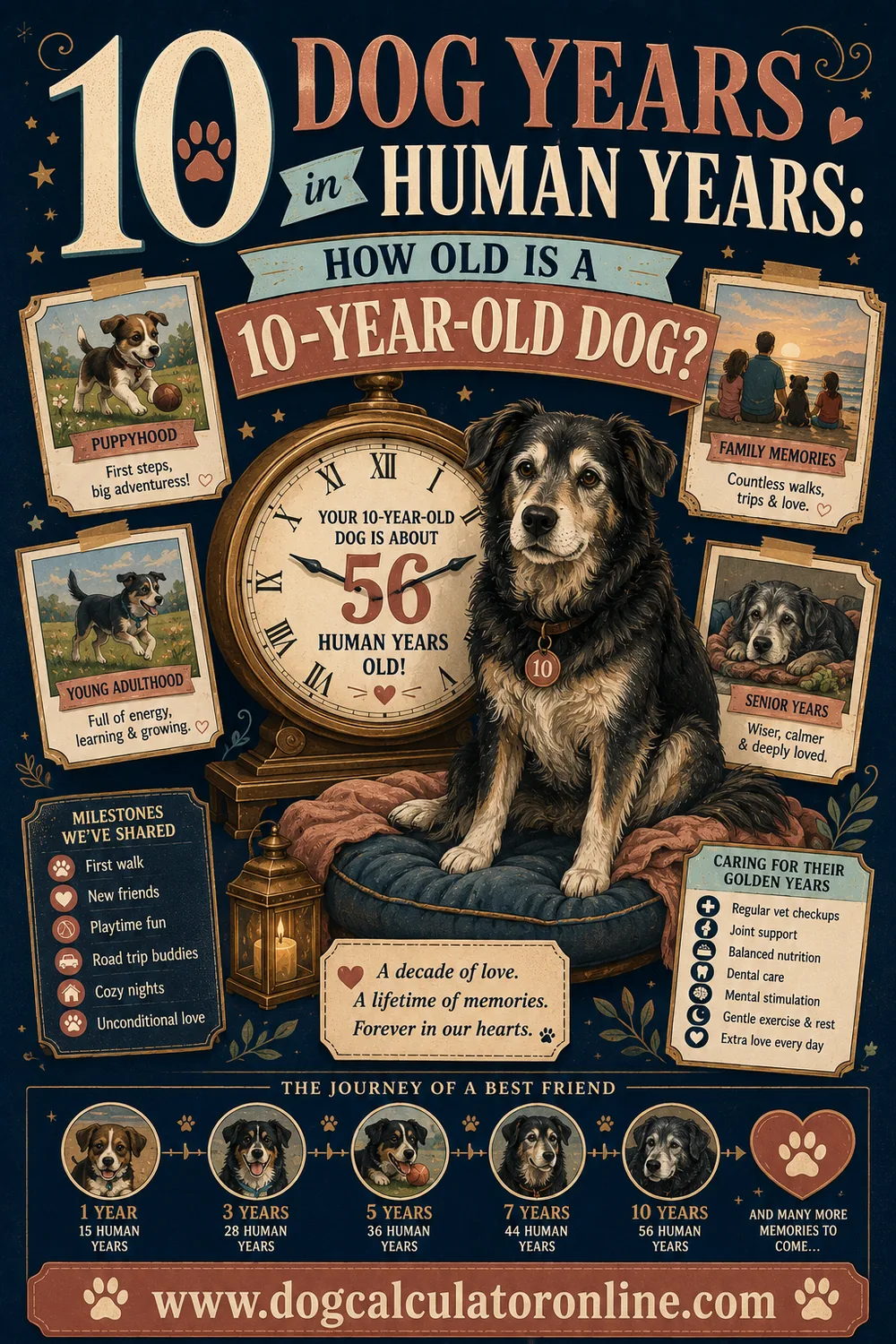
Thirty-two is a good translation, because a 4-year-old dog behaves very much like a person in their early thirties. Fully grown, physically at or near peak, past the impulsive years, and settled into who she is going to be.
The adolescent phase is over. Most dogs go through a genuinely difficult stretch between roughly six months and two and a half years, when previously reliable recall evaporates and household rules seem to be renegotiated daily. By four that has resolved. Training generally sticks, and the dog you have is close to the dog you will have for years.
Physical condition is at its best. Muscle mass, stamina, joint health and coat quality are typically at their peak between about two and five. A healthy 4-year-old dog can usually do more, for longer, with faster recovery, than at any other point in her life.
Energy is high but no longer frantic. Working and sporting breeds at four are in their prime and still need a real job. What changes is that the energy is directed rather than scattered.
Personality is settled. Whatever a dog is like socially at four, with strangers, with other dogs, with noise, is largely who she is. That is not fatalism, since behavior can absolutely be worked on, but the raw temperament is no longer moving much.
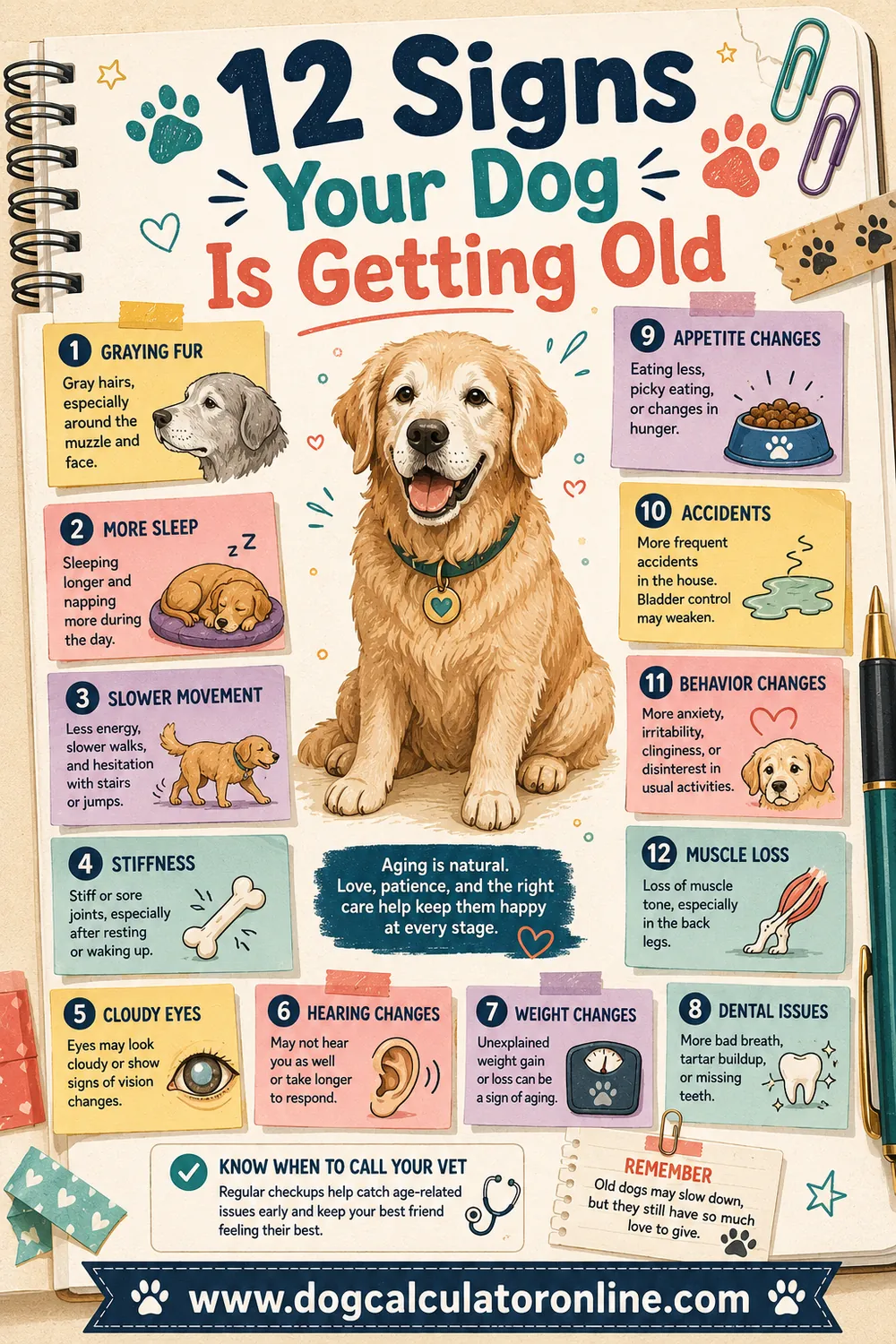
Nothing much has started fading yet. Hearing, sight, and cognition are all intact. The gray muzzle, the cloudy lens, the deliberate approach to stairs, all of that is years away for a small or medium dog and still some way off for most large ones.
4 Years Old, Broken Out by Breed
If weighing your dog is inconvenient, here is where familiar breeds land at four. Because three of the four size classes share a figure, this table is short on variety and long on reassurance.
| Breed | Size class | 4 years is about |
|---|---|---|
| Chihuahua | Small | 32 |
| Dachshund | Small | 32 |
| Yorkshire Terrier | Small | 32 |
| Shih Tzu | Small | 32 |
| Pug | Small | 32 |
| Beagle | Medium | 32 |
| Border Collie | Medium | 32 |
| Cocker Spaniel | Medium | 32 |
| French Bulldog | Medium | 32 |
| Australian Shepherd | Medium | 32 |
| Labrador Retriever | Large | 32 |
| Golden Retriever | Large | 32 |
| German Shepherd | Large | 32 |
| Boxer | Large | 32 |
| Doberman | Large | 32 |
| Great Dane | Giant | 38 |
| Saint Bernard | Giant | 38 |
| Newfoundland | Giant | 38 |
| Mastiff | Giant | 38 |
Breed is a shortcut for weight, not an independent factor. Two Labradors at very different body weights will age slightly differently, and a mixed breed goes by the scale.
Care Priorities for a 4-Year-Old Dog
Four is the easiest age to coast through, and coasting is the main risk. Nothing is obviously wrong, so nothing gets checked. Most of the conditions that shape a dog's later years are being set up quietly right now.
Establish a baseline while she is healthy. A blood panel taken from a healthy 4-year-old is far more useful than the first one taken at ten, because it tells your vet what normal looks like for this particular dog. Values that would look borderline in the abstract are easy to interpret when there is a comparison from six years earlier.
Keep her lean, and be honest about it. Staying lean throughout life is one of the most consistent factors associated with dogs who age well. Four is where creeping weight gain usually begins, because activity drops slightly after adolescence while the food bowl stays the same. Being able to feel the ribs easily without pressing hard is the usual guide, and a visible waist from above is the other.
Get on top of teeth now. Dental disease starts early and progresses quietly, and by the time breath is noticeably bad there is usually meaningful disease under the gumline. Daily brushing sounds excessive and is genuinely the highest-value habit you can build at this age. Ask your vet what her mouth actually looks like at the next visit rather than assuming.
Build the exercise habit that will carry her. A dog who has been consistently, moderately active through her prime carries more muscle into her senior years, and muscle is what supports aging joints. Sustained regular exercise beats occasional weekend intensity, especially for large breeds where sudden hard efforts on a soft-conditioned body are how injuries happen.
Keep training alive. Four-year-old dogs learn well and enjoy it. Short sessions with new cues, scent work, or anything that makes her solve a problem all keep the mental machinery in good order. Dogs who are used to learning tend to stay engaged longer into old age.
Watch large and giant breeds a little harder. A large dog at four is at the same conversion figure as a small dog, but her clock starts moving faster in about two years. A giant breed is already at 38 and is closer to middle age than she looks. That is the argument for building the weight, exercise and dental habits now rather than at seven.
Is 4 Old for a Dog?
No. Four is young adulthood by any measure and the middle of the best physical years for every size class.
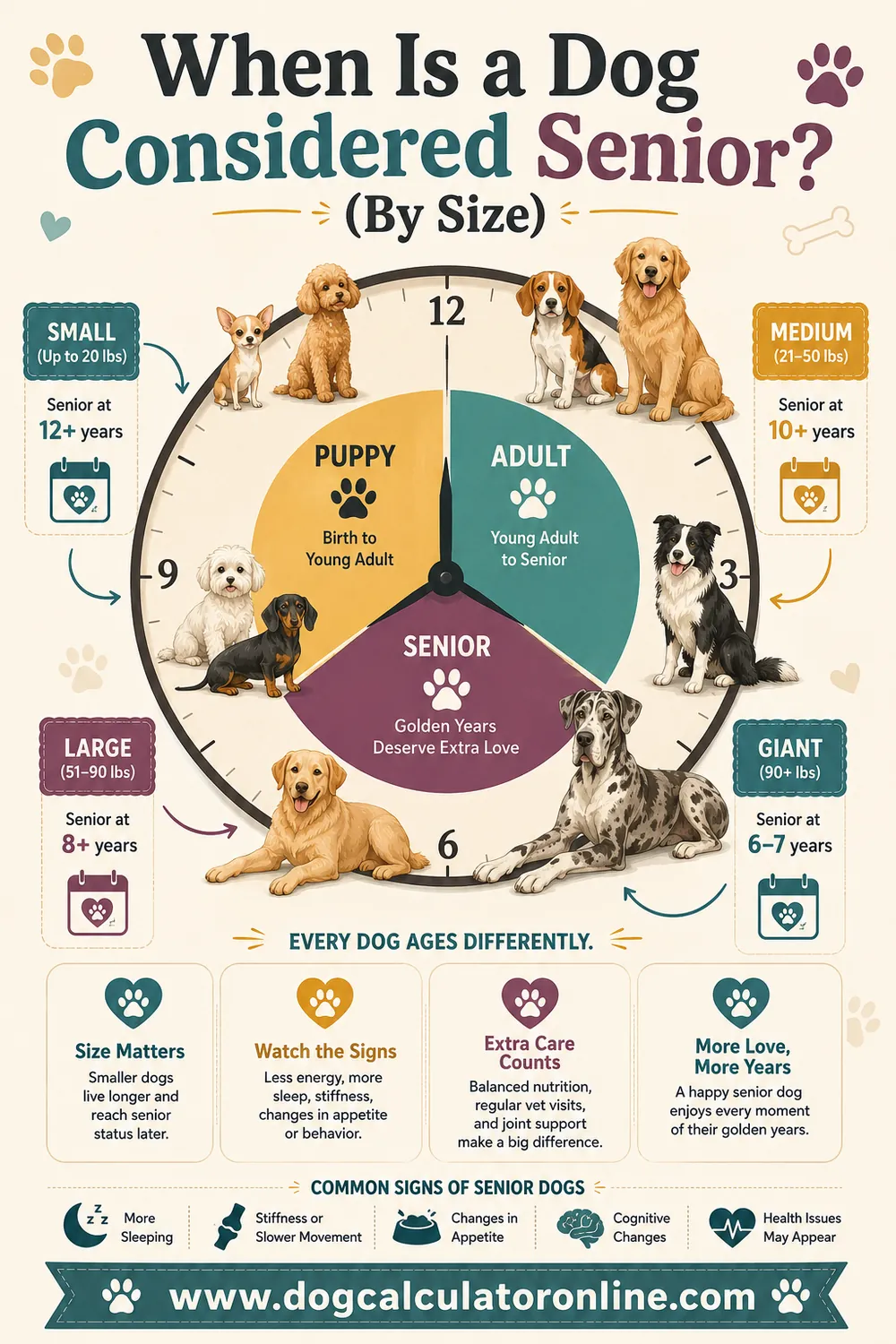
For a small dog, four is barely a quarter of the way through a life that often runs to fifteen or sixteen. For a medium dog, it is comfortably in the first third. For a large dog, four is prime adulthood, with the senior years still three or four years out. Even for a giant breed, where lifespans commonly run seven to ten years, four is mature rather than old, though it is closer to the midpoint than owners of giant dogs usually expect.
The useful frame at four is not counting anything down. It is recognizing that this is the stretch where the habits get set. Weight, teeth, conditioning and a relationship with a vet who knows your dog's baseline are the four things that show up again and again in dogs who reach old age comfortably, and all four are easiest to establish now, while nothing hurts and nothing is wrong. If you want to see where the road goes, the pages for 6 dog years and 9 dog years pick up the story where this one leaves off.
Frequently Asked Questions
How old is a 4-year-old dog in human years? About 32 for a small, medium or large dog, and roughly 38 for a giant breed. Four is one of the few ages where three of the four size classes share the same figure, because the size-driven gap in aging does not open up until year six.
Why is 4 the same number for small, medium and large dogs? Because dogs of all sizes mature at broadly the same rate for the first five years. What differs between sizes is when age-related decline begins, not how quickly a puppy becomes an adult, and that decline does not start separating the size classes until around year six.
Is a 4-year-old dog still considered young? Yes. Four is young adulthood, and for most dogs it sits in the middle of the strongest physical years. Small dogs are roughly a quarter of the way through a typical lifespan at four, and even large breeds still have several years before the senior stage.
What health checks does a 4-year-old dog need? An annual exam with your vet, current vaccinations and parasite prevention, and a look at her teeth. A baseline blood panel taken while she is healthy is also worth asking about, because it gives your vet something to compare against years later. Anything specific to your dog is a conversation for your vet.