17 Dog Years in Human Years: What Age Is Your Dog Really?
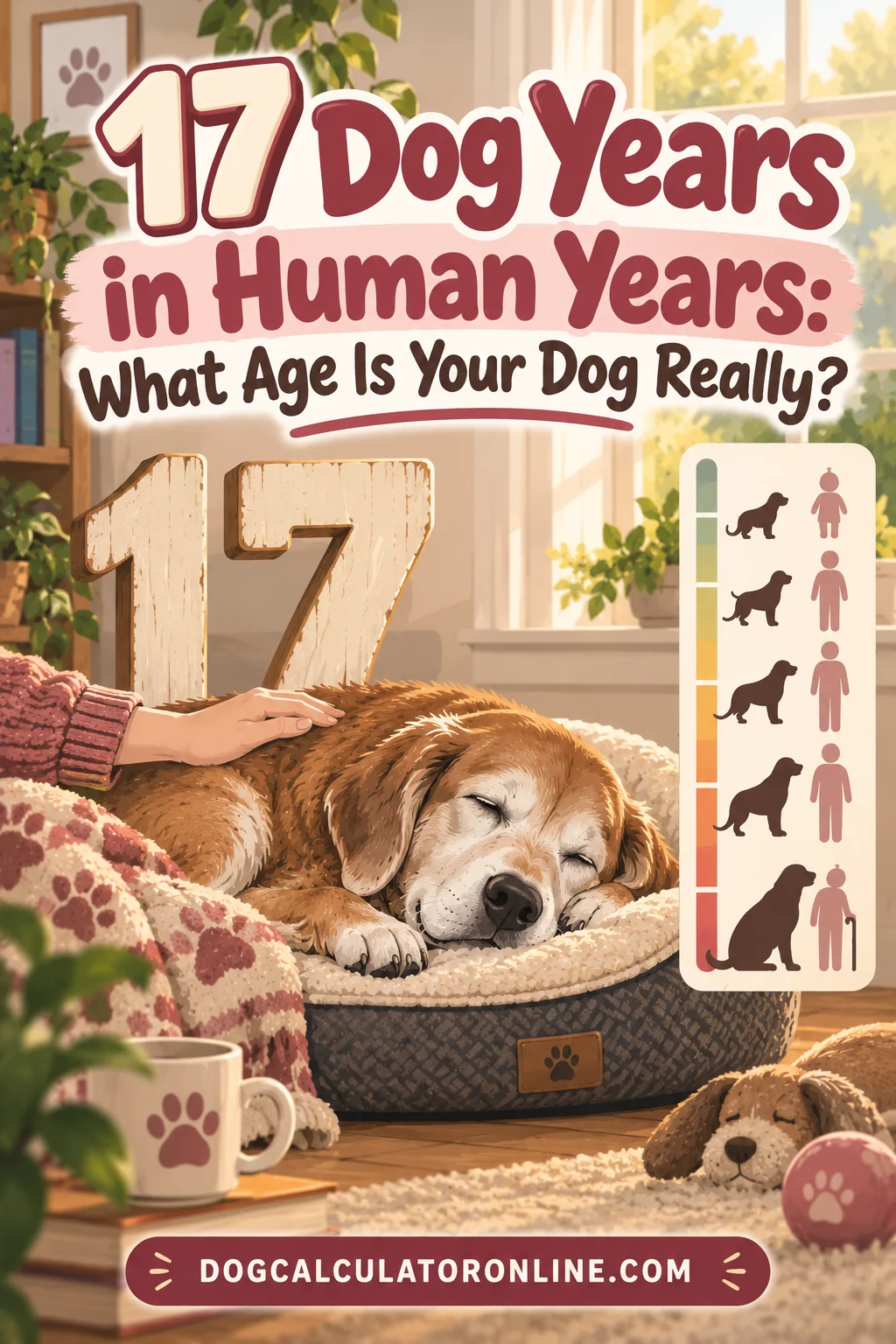
A 17-year-old dog is about 84 in human years if she is small, 92 if medium, and around 104 if she is a large breed. Extending the same curve puts a giant breed near 128, though almost no giant dog reaches this age. Seventeen is genuinely old for every size class, and if you are reading this with a 17-year-old dog asleep nearby, you have done something most owners never get to do.
That is the first thing worth saying. Seventeen is not a number most dogs see. Getting a dog there takes some luck with genetics and a lot of ordinary, unglamorous care repeated over many years. The rest of this page is about what the number means and, more usefully, what makes a dog this age comfortable.
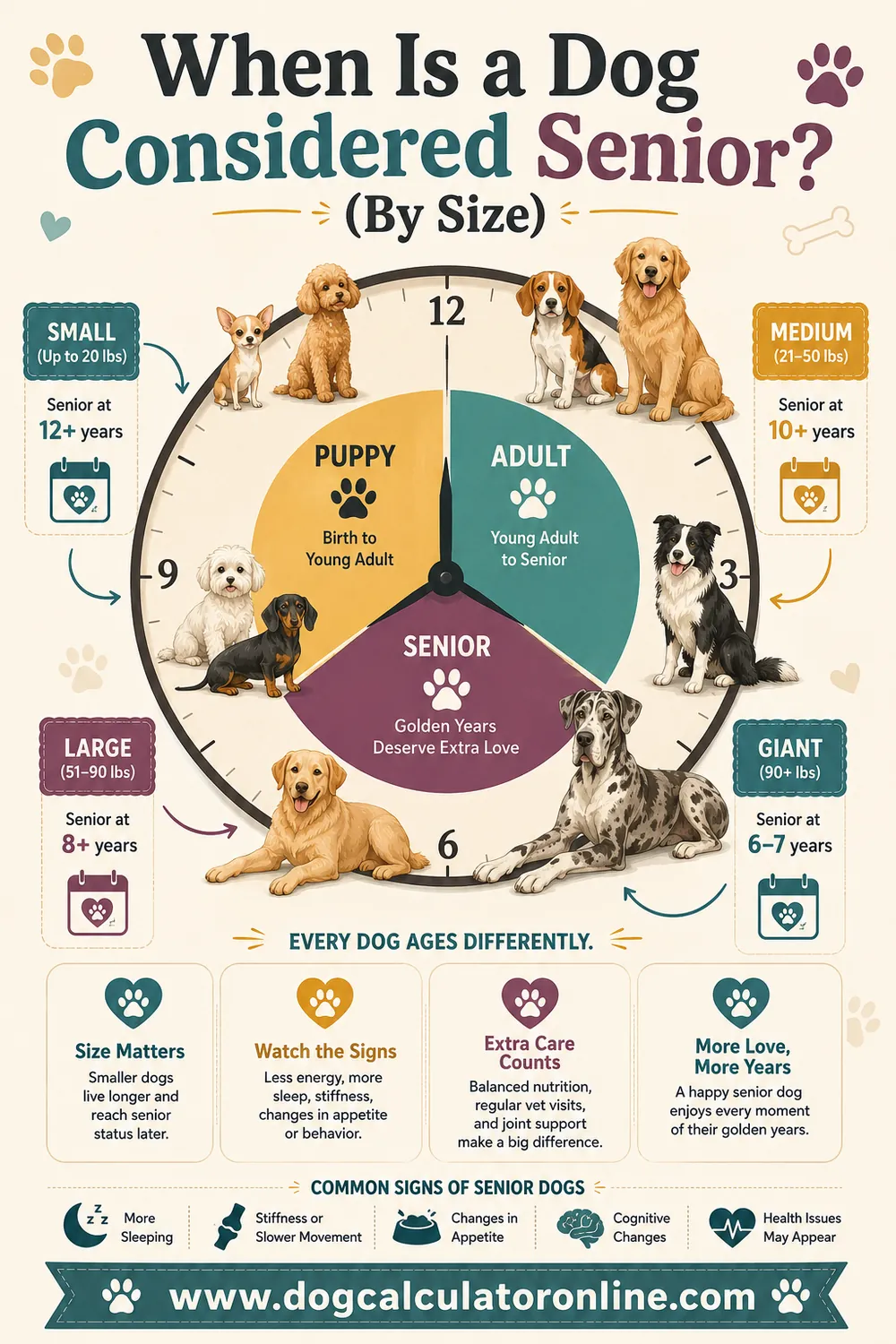
The Quick Answer by Size
| Your dog's size | Adult weight | 17 years is about |
|---|---|---|
| Small | Up to 20 lb | 84 human years |
| Medium | 21-50 lb | 92 human years |
| Large | 51-100 lb | 104 human years |
| Giant | Over 100 lb | Around 128, essentially unheard of |
The giant row deserves an honest note. Giant breeds typically live seven to ten years, so a 17-year-old Great Dane or Mastiff would sit far outside anything documented. The figure of 128 is what you get by extending the same curve that produces every other number on this chart, not something anyone has measured. If you have a 17-year-old giant breed, the chart is not the interesting fact about your dog.
If you want the figure for a different age, or for a dog sitting near a weight boundary, the dog age calculator on this site runs the same size-banded method.
What 17 in Dog Years Looks Like on the Chart
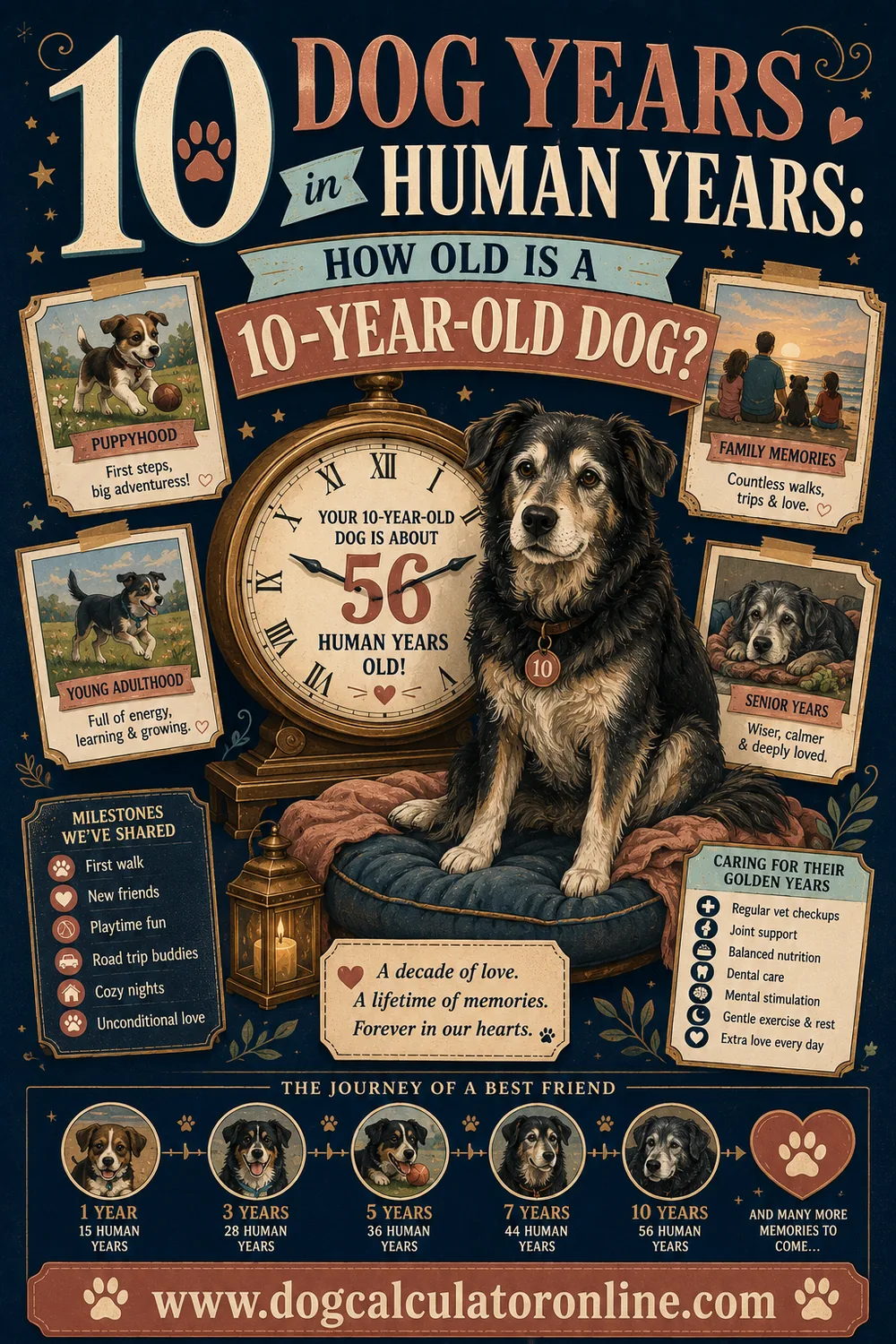
Seventeen sits near the far edge of published conversion tables. Most stop at sixteen, because so few dogs go beyond it that the averages thin out. The figures below extend the same size-adjusted curve used for the years before, which is the honest way to answer the question.
| Dog's age | Small (≤20 lb) | Medium (21-50 lb) | Large (51-100 lb) |
|---|---|---|---|
| 12 years | 64 | 69 | 77 |
| 13 years | 68 | 74 | 82 |
| 14 years | 72 | 78 | 88 |
| 15 years | 76 | 83 | 93 |
| 16 years | 80 | 87 | 99 |
| 17 years | 84 | 92 | 104 |
| 18 years | 88 | 96 | 110 |
Two honest caveats about those last rows. First, the conversion is a model rather than a measurement, and it gets rougher the further out it runs. Second, at seventeen the human-equivalent figure tells you much less than what you can see with your own eyes. A comfortable, alert 17-year-old dog is doing better than the chart suggests, and a dog who is struggling is doing worse. Trust the dog over the table.
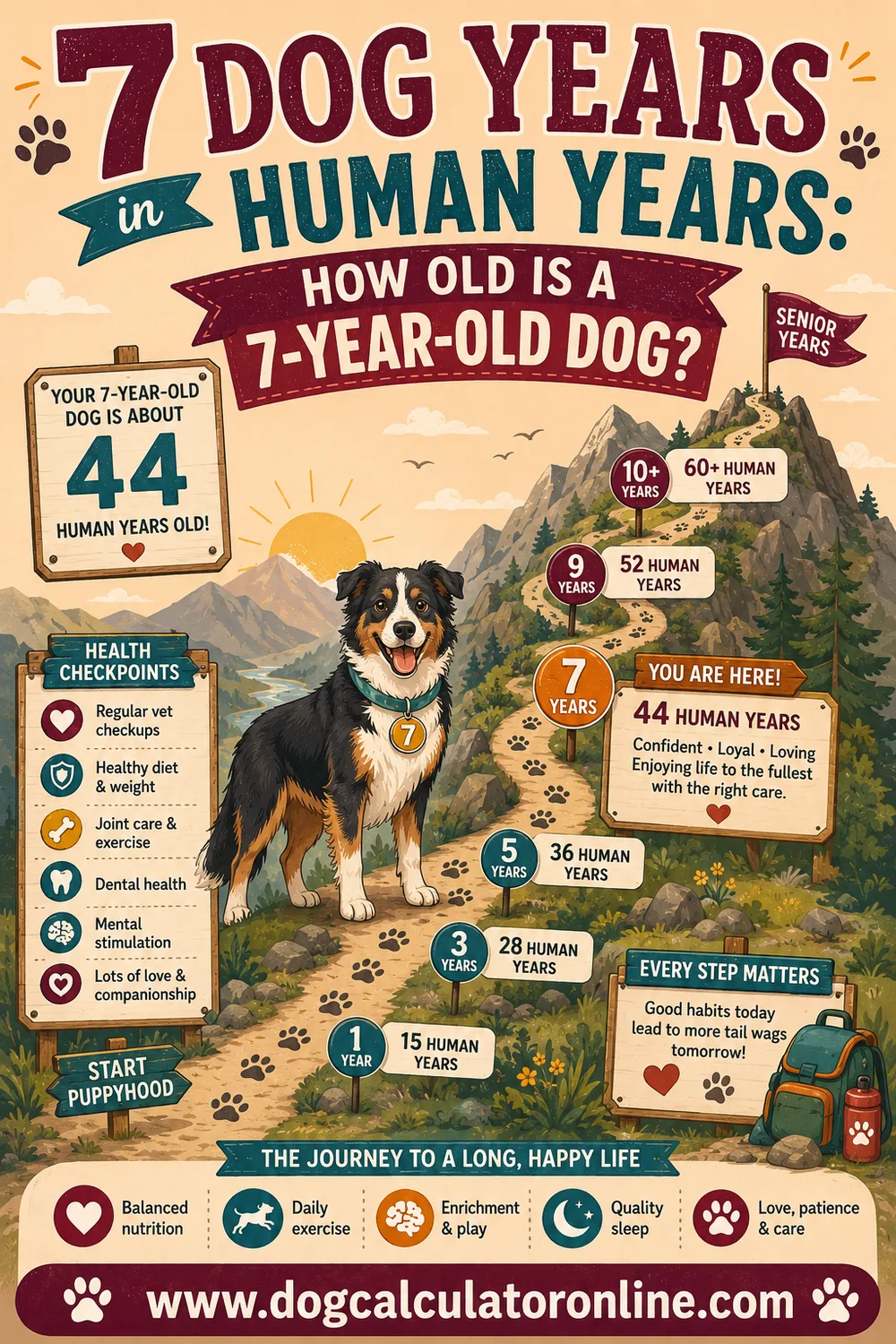
The seven-year rule, for what it is worth, would give 119 for a 17-year-old dog of any size. Nobody believes that figure, and it is a neat illustration of why the rule was always broken. It came from dividing an average human lifespan by an average dog lifespan sometime in the mid-twentieth century, not from how dogs actually age, and it ignores body size entirely.
Which Dogs Reach 17, and Why
Small breeds dominate extreme old age. Chihuahuas, Dachshunds, Toy Poodles, Miniature Pinschers, Jack Russells, Shih Tzus, Lhasa Apsos, Pomeranians and small terrier mixes are the dogs most often reaching seventeen and beyond. Small mixed breeds do particularly well.
Medium dogs at seventeen are uncommon but real. Beagles, Cocker Spaniels and small herding mixes get there often enough that no vet is astonished by one.
Large dogs at seventeen are exceptional. Most large breeds average ten to twelve years, so seventeen puts a Labrador or a German Shepherd well past anything typical for her size.
The factors that come up again and again in dogs who reach these ages are not exotic. Staying lean their whole lives. Being spayed or neutered. Consistent veterinary care and good dental health. Regular moderate exercise sustained over years rather than in bursts. Being a small breed or a mixed breed without a heavy load of inherited conditions. Genetics you cannot change. The rest of it you already did, which is how your dog got here.
What 17 Actually Looks Like
Every dog is different at this age, but a few things are close to universal, and knowing they are ordinary helps.
Sleep takes up most of the day. Eighteen to twenty hours is common. Deep sleep means she may not hear you come in, and she may startle if woken by touch. Approaching where she can see you, or letting her feel your footsteps through the floor, saves her that jolt.
Getting up is the hard part, not walking. Many very old dogs walk perfectly well once they are up and moving. The struggle is the first push off the floor, especially on a smooth surface, and especially after a long nap.
Hearing and sight both fade. Hearing usually goes first and often almost completely. Sight tends to hold longer but dims. A dog who has lost both usually navigates the house she knows perfectly well, which is a good argument for not rearranging furniture.
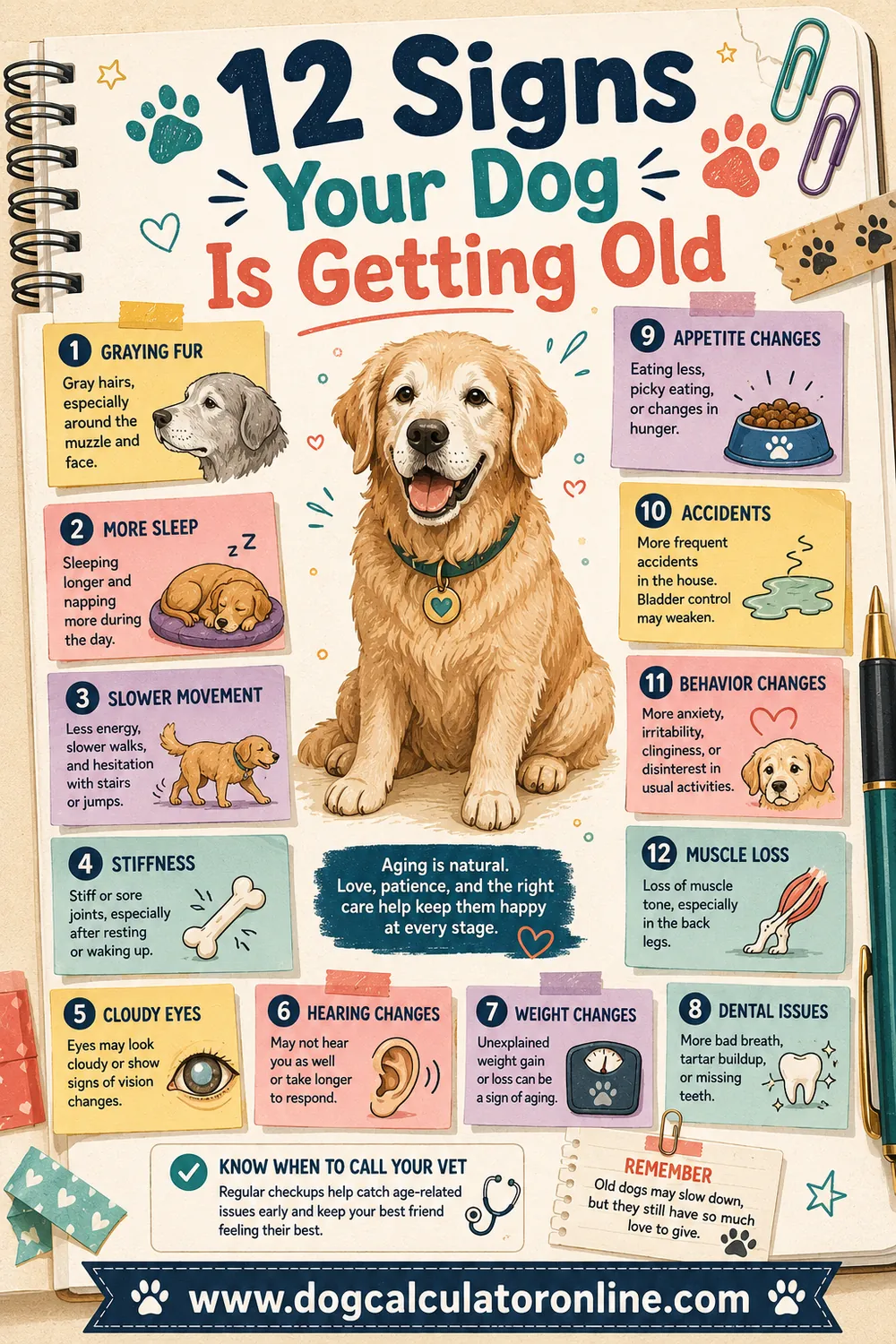
Her body shape changes. Muscle over the hips and shoulders thins, the topline may dip, and she may feel bonier even at a healthy weight. The coat often gets thinner or coarser, and old dogs feel the cold much more than they used to.
Habits get more particular. Many old dogs become deeply attached to a spot, a routine, a person. Some get clingier. Some sleep apart from the household. Some pace in the evening. All of that is within the ordinary range at seventeen.
Good days and slower days alternate. This is normal and it is not a trend line. Owners often read one slow afternoon as a decline and one bright morning as a recovery. Neither is reliable on its own, which is why the practical advice below is about watching patterns over a week rather than reacting to a single day.
Comfort: The Things That Actually Help
At seventeen, comfort is the whole agenda, and most of what works is physical and specific.
Fix the floors first. This is the single highest-impact change in most homes. Hardwood, tile and laminate are genuinely difficult for a dog with weak back legs, and the fear of slipping makes dogs stop moving long before their muscles force them to. Runners, yoga mats, rubber-backed rugs or carpet tiles laid along her regular routes, especially from her bed to the door and to the water bowl, can change a dog's mobility overnight. Keeping the fur between her paw pads trimmed short helps her get real traction too.
Raise the bowls. Food and water at chest height spare a stiff neck and shoulders, and dogs who find bending painful often start drinking more once it stops hurting.
Get the bed right. A thick orthopedic or memory-foam bed, low enough to step onto without a climb, in a warm draft-free spot away from the door. Many old dogs sleep better with a second bed near where the family sits, so she does not have to choose between comfort and company. If she gets cold, a fleece blanket or a dog sweater indoors is not fussy, it is practical.
Remove the jumps. A ramp or a set of low steps to the couch, the bed or the car takes away the moments most likely to cause a bad landing. Most dogs learn a ramp quickly if it is introduced flat and gently.
Shorten the walks and keep them. Five slow minutes of sniffing has real value and is not the same as nothing. Muscle disappears fast without use, and less muscle means less support for sore joints. Let her set the pace, turn back before she is tired, and count the sniffing as the point of the outing rather than a delay.
Leave a night light on. Dim vision plus a dark hallway is how old dogs get stuck in corners. Low lighting along her route to the door at night helps more than it sounds like it should.
Plan for accidents without making them a problem. More frequent trips outside, a puppy pad near the door, and washable bedding take the stress out of something that is not her fault. Do not scold an old dog for an accident. If accidents are new or sudden, mention it to your vet, since there are causes worth ruling out.
Working With Your Vet at 17
Everything medical at this age belongs with your veterinarian, who can examine your dog and read her bloodwork. A few things are worth raising specifically.
Ask about pain, directly. Dogs hide pain well, and owners often read stiffness as simply old. Osteoarthritis is one of the most under-treated conditions in veterinary medicine, and it is treatable at any age. Ask your vet outright whether your dog is in pain and what the options are. Never give human pain relievers. Ibuprofen, acetaminophen, naproxen and aspirin can cause serious harm to dogs.
Ask about her mouth. Dental disease is close to universal at seventeen, and chronic oral infection puts real strain on the body. Whether anything should be done about it at this age is a genuine judgment call and exactly the kind of question your vet is there for.
Mention any confusion. Cognitive dysfunction, the canine version of dementia, can show up as nighttime pacing, staring at walls, getting stuck behind furniture, forgetting house training, or seeming lost in a familiar room. It is worth reporting, because there are things that help.
Keep the checkups. Twice-yearly senior exams with bloodwork are the usual recommendation. A great deal can change in six months at this age, and most of what matters most shows up in lab work before it shows up in behavior.
These changes are worth a prompt call rather than another week of watching:
- A noticeable change in drinking or urinating
- Weight loss without a diet change
- A new cough, or labored breathing
- Sudden reluctance or inability to use the back legs
- Loss of appetite lasting more than a day or two
- Any collapse, disorientation, or seizure
- Straining, or blood anywhere it should not be
None of these necessarily mean something serious. All of them are better answered by your vet than by the internet.
Thinking About Quality of Life
Owners of very old dogs often want a way to think about how she is doing that is steadier than their own mood on a given day. The approach most vets suggest is simple: pick a handful of things that matter to your particular dog and check them regularly rather than continuously.
The usual list covers whether she is eating and drinking with interest, whether she can get up and move without obvious distress, whether she is clean and comfortable, whether she still responds to the people and routines she has always liked, and whether the good days clearly outnumber the difficult ones.
Some people keep a short note on a calendar, a word or two a day. That sounds clinical and is actually kind, because it replaces anxious guessing with something you can look back at across a month. If any of it worries you, your vet has seen many dogs at this stage and can talk it through with you. That conversation is a normal part of caring for an old dog, and it is easier to have earlier than later.
What is not useful is trying to predict anything from a chart. No conversion table knows your dog, and nobody can tell you how long you have. What you can do is make today comfortable, which is squarely within your control.
Is 17 Old for a Dog?
Yes, in every size class, and for the right reasons.
For a small dog, seventeen is a long life well lived. Small breeds are the ones who most often get here, and plenty of 17-year-old small dogs are still doing a slow lap of the yard and waiting by the door at dinner time.
For a medium dog, seventeen is uncommon and something to be quietly proud of.
For a large dog, seventeen is remarkable. She has outlived the typical span for her size by years.
For a giant breed, seventeen is outside anything the charts describe.
The useful frame at this age is not the number at all. It is the ordinary stuff: a warm bed, a floor she can walk on without fear, a vet who knows her, food she still wants, and the company of the people she picked. That is most of what makes a very old dog's days good, and none of it requires anything extraordinary. The 18 dog years page continues the same chart if you want to see the year ahead.
Frequently Asked Questions
How old is a 17-year-old dog in human years? About 84 for a small dog, 92 for a medium dog and around 104 for a large one. Extending the same curve puts a giant breed near 128, though almost no giant dog reaches seventeen. The old times-seven rule would give 119 for every size, which nobody takes seriously.
Is 17 a long life for a dog? Yes, by any measure. Seventeen is most common in small breeds and small mixes, uncommon in medium dogs, and exceptional in large ones. Reaching it usually reflects a combination of genetics and years of steady care.
How can I make my 17-year-old dog more comfortable? Non-slip runners on hard floors, a thick orthopedic bed in a warm spot, raised food and water bowls, a ramp instead of any jump, short slow walks that she sets the pace for, and a night light along her route to the door. Ask your vet about pain management, because stiffness is treatable and is easy to mistake for simple old age.
Should a 17-year-old dog still go for walks? Yes, gently and briefly. Muscle disappears quickly without use, and weaker muscles give sore joints less support, so several very short outings are better than none or than one long one. Let her choose the pace, let her sniff, and turn back before she is tired. Your vet can advise on what is right for your dog specifically.