11 Dog Years in Human Years: What Age Is Your Dog Really?
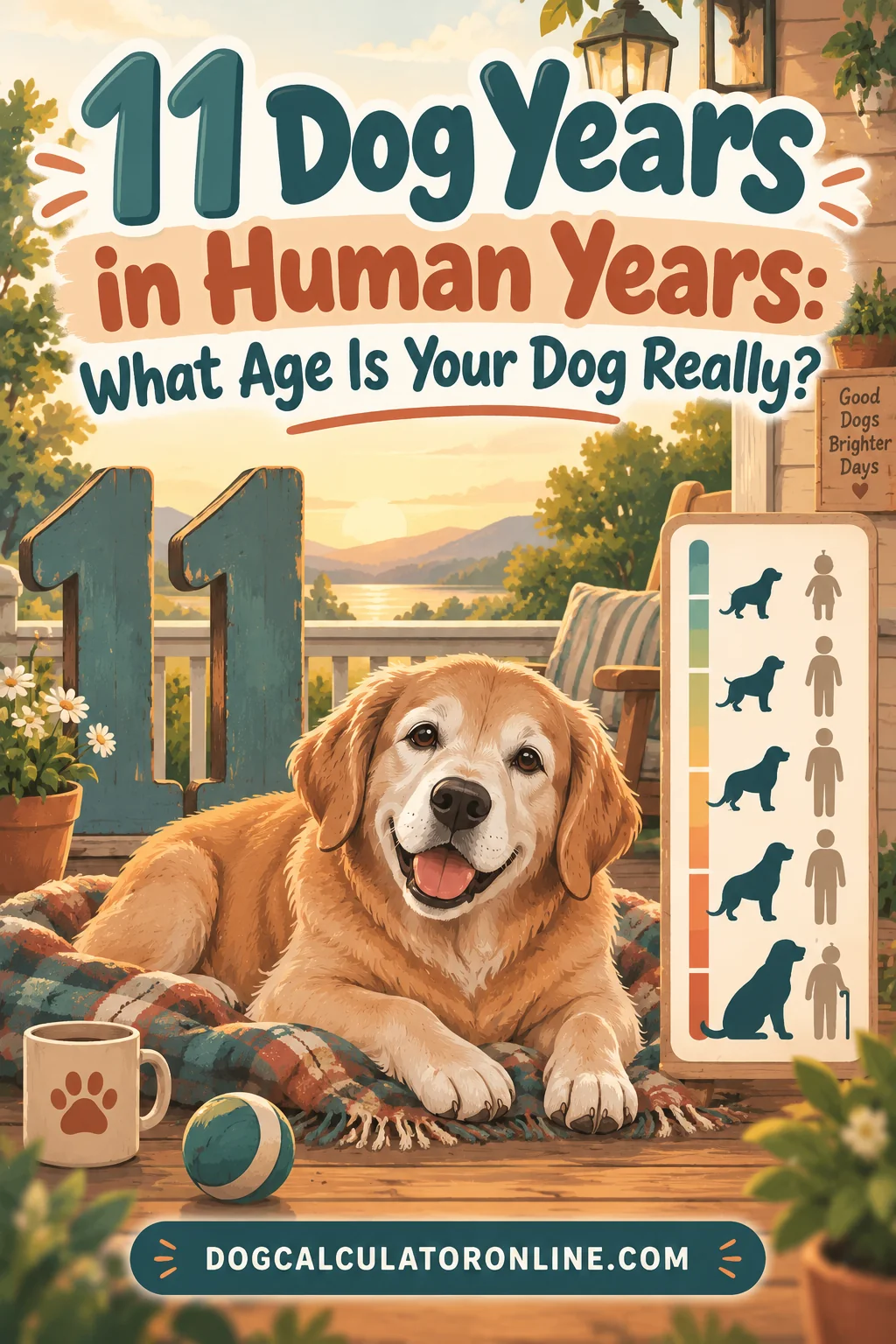
An 11-year-old dog is about 60 in human years if she is small, 65 if medium, 72 if large, and roughly 86 if she is a giant breed. By eleven, every size class has crossed into the senior years, and the gap between the smallest and largest dogs has opened to twenty-six human years.
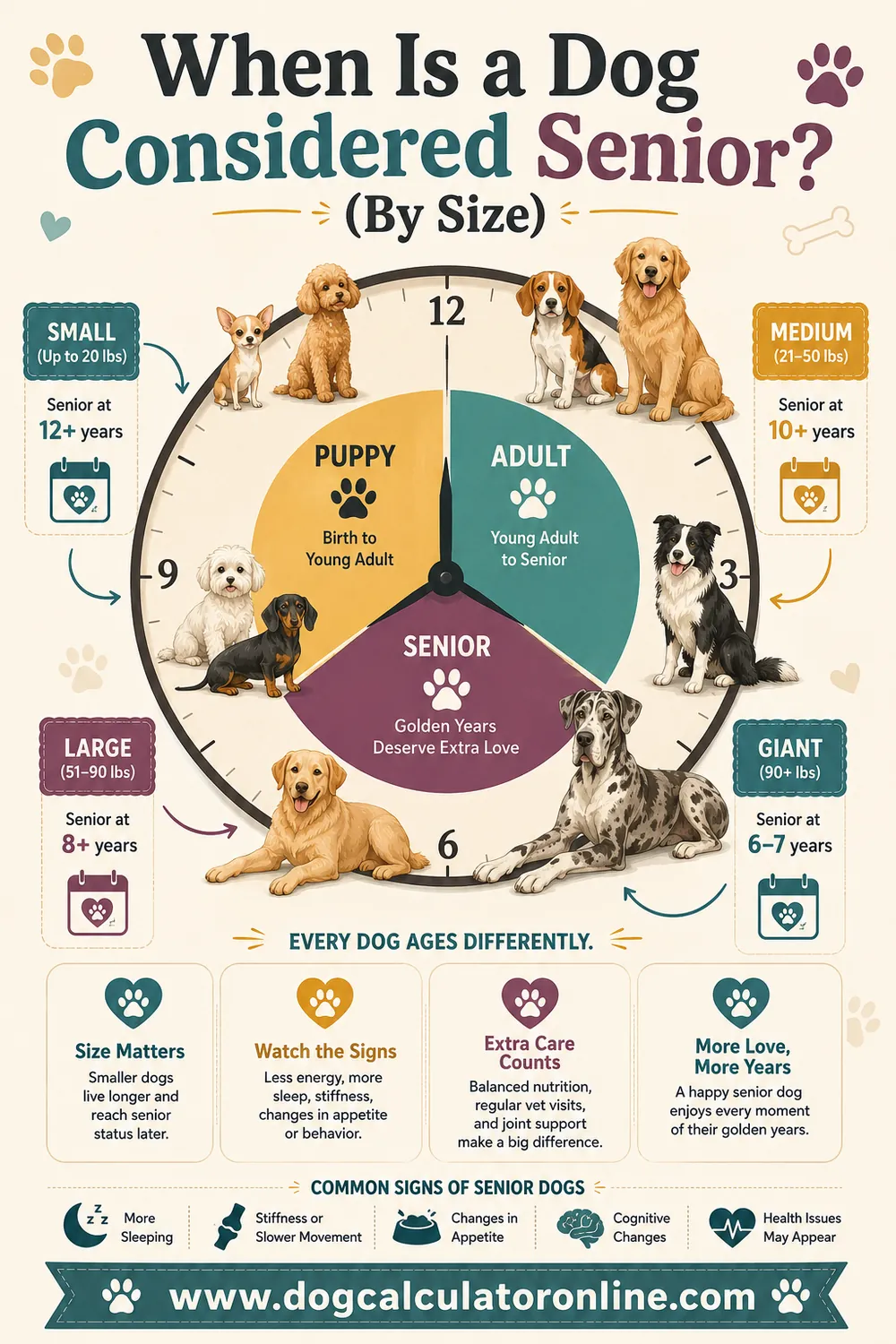
Eleven is the age where the word senior stops being a matter of debate. A small dog reaches it here, a large dog reached it a few years back, and a giant breed has been there since about six. What changes at eleven is not that your dog is suddenly old, but that the questions worth asking have shifted from training and conditioning to comfort, screening and catching things early.
The Quick Answer by Size
| Your dog's size | Adult weight | 11 years is about |
|---|---|---|
| Small | Up to 20 lb | 60 human years |
| Medium | 21-50 lb | 65 human years |
| Large | 51-100 lb | 72 human years |
| Giant | Over 100 lb | 86 human years |
Size class goes by adult weight, which at eleven is simply what your dog weighs now, assuming she has held her condition. For a mixed breed, use the scale rather than the ancestry panel. A 60-pound mix ages on the large-dog curve regardless of what the DNA test reports.
If you want the figure for a different age, or for a dog sitting near a weight boundary, the dog age calculator on this site runs the same size-banded chart.
Why 11 in Dog Years Splits So Widely by Size
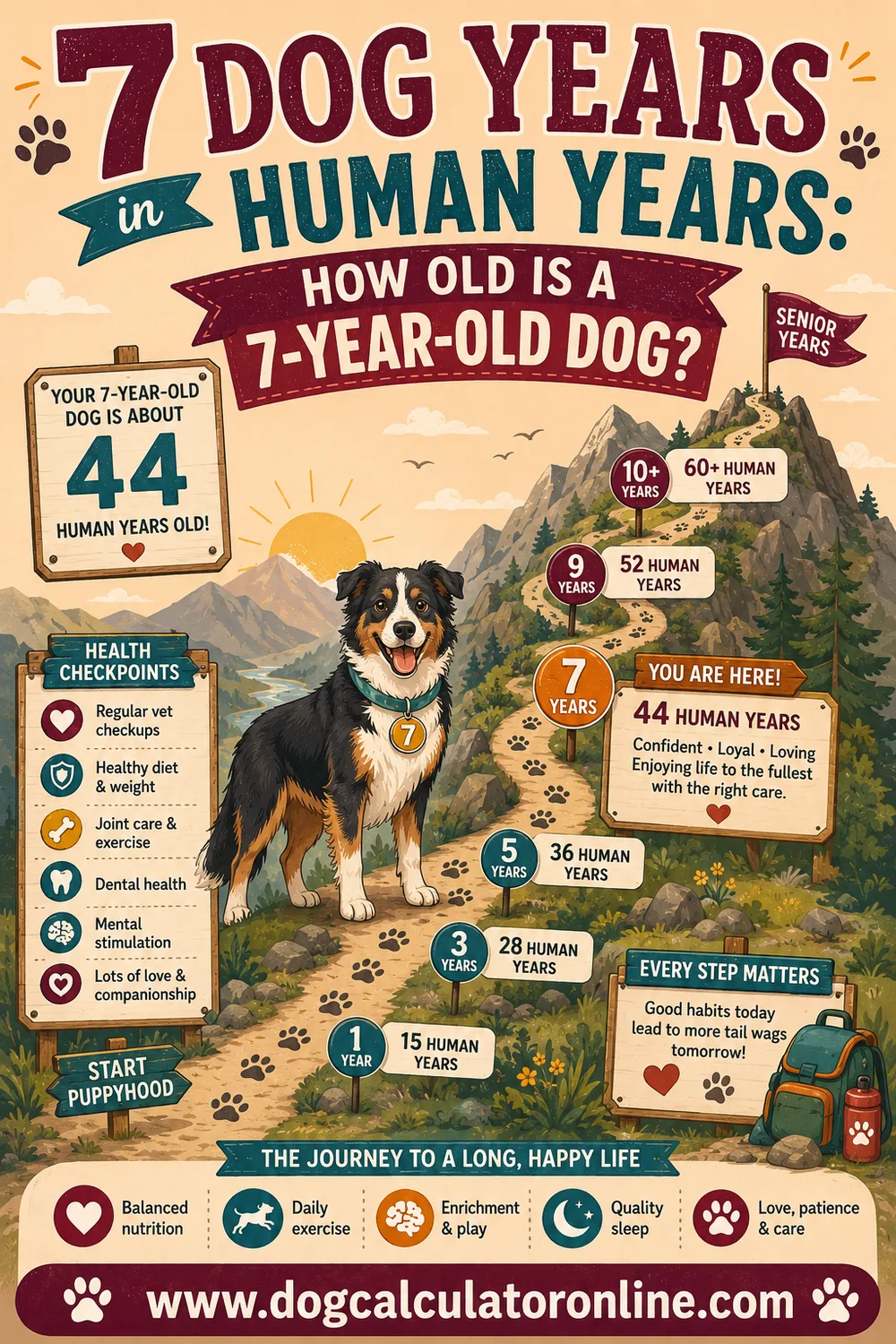
Small, medium and large dogs age at effectively identical rates for their first five years. The columns run 15, 24, 28, 32, 36 with no adjustment. Year six is where they fork, to 40, 42, 45 and 49, and every year after that the spread widens.
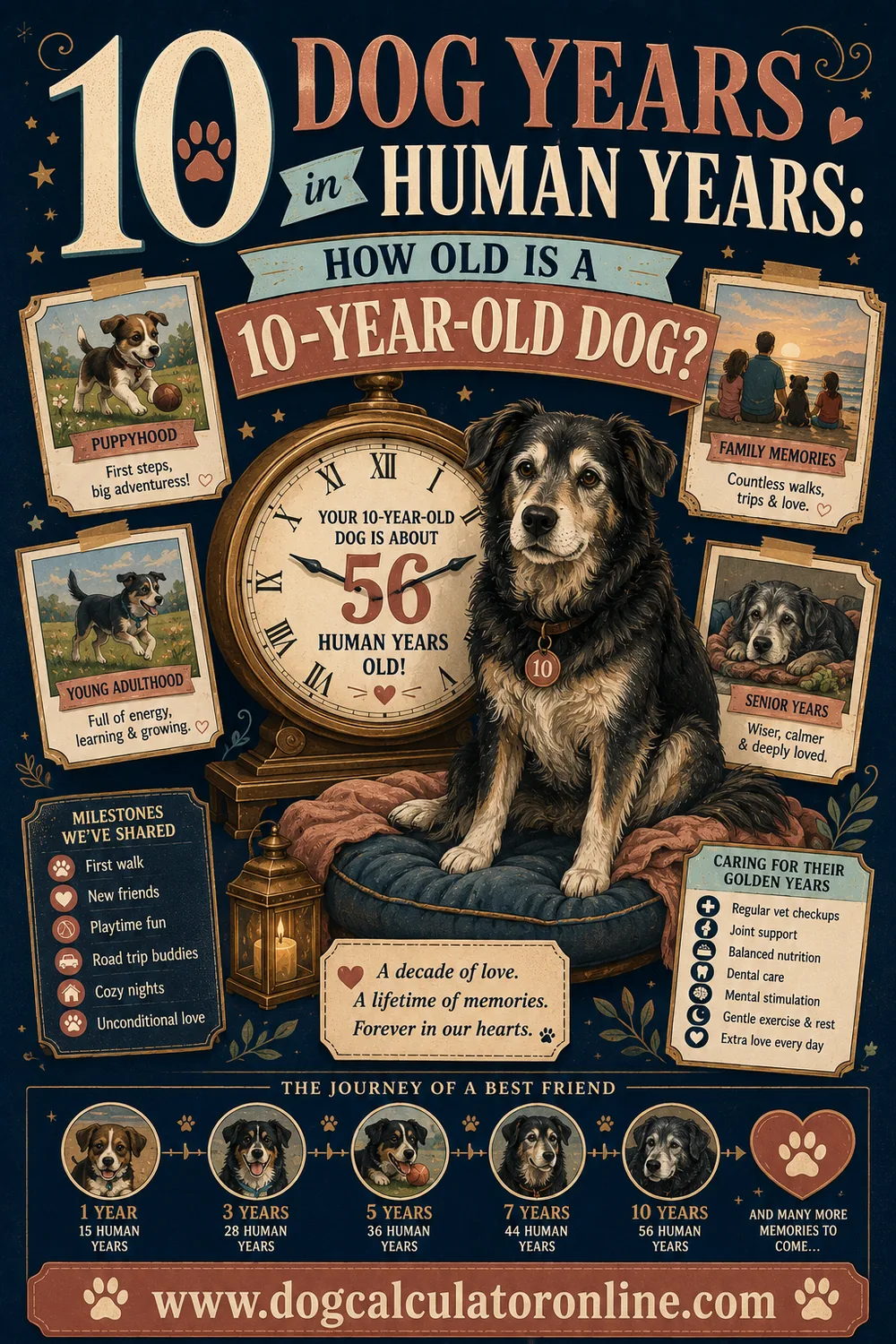
By eleven, five years of divergence have accumulated. Here is what that looks like on the way in and out:
| Dog's age | Small (≤20 lb) | Medium (21-50 lb) | Large (51-100 lb) | Giant (100+ lb) |
|---|---|---|---|---|
| 6 years | 40 | 42 | 45 | 49 |
| 8 years | 48 | 51 | 55 | 64 |
| 9 years | 52 | 56 | 61 | 71 |
| 10 years | 56 | 60 | 66 | 79 |
| 11 years | 60 | 65 | 72 | 86 |
| 12 years | 64 | 69 | 77 | 93 |
| 13 years | 68 | 74 | 82 | 100 |
| 14 years | 72 | 78 | 88 | 107 |
| 15 years | 76 | 83 | 93 | 114 |
Notice what each additional year costs. A small dog picks up about four human years annually at this stage. A medium dog picks up four to five, a large dog five to six, and a giant breed about seven. That difference in slope is why the columns keep pulling apart rather than settling into a fixed gap.
Why size matters this much is still an open question in canine biology. The leading explanation is growth rate. A giant puppy goes from about a pound at birth to well over a hundred pounds in a year, which involves far more cell division and much higher levels of circulating growth factors than a small dog ever experiences, and that pace appears to carry a long-term cost in earlier age-related change. Whatever the mechanism, the pattern is consistent enough that veterinarians build their life-stage guidance around body size rather than a single all-breeds timeline.
Forget the Seven-Year Rule
Multiplying by seven gives 77 for an 11-year-old dog of any size. That is far too high for a small dog, too high for a medium one, roughly right by accident for a large one, and too low for a giant breed. It manages to be wrong in three directions at once.
The rule was never based on biology. It appears to trace back to a rough mid-twentieth-century observation that people lived about 70 years and dogs about 10, and 70 divided by 10 is easy to remember. That is the entire foundation.
It fails most visibly with puppies, since a one-year-old dog has adult teeth, has reached adult height and in most breeds can reproduce, none of which is true of a seven-year-old child. It fails again at the senior end by ignoring size completely.
At eleven the error matters practically. Seventy-seven suggests a small dog who should be treated as frail, when a healthy 11-year-old Dachshund at 60 is closer to an active retiree with years of ordinary life left. In the other direction it understates a giant breed by nine years at exactly the age when close attention is most valuable.
What 11 Actually Looks Like
The number is a translation. What you live with is the life stage, and at eleven the changes are real but usually gradual.
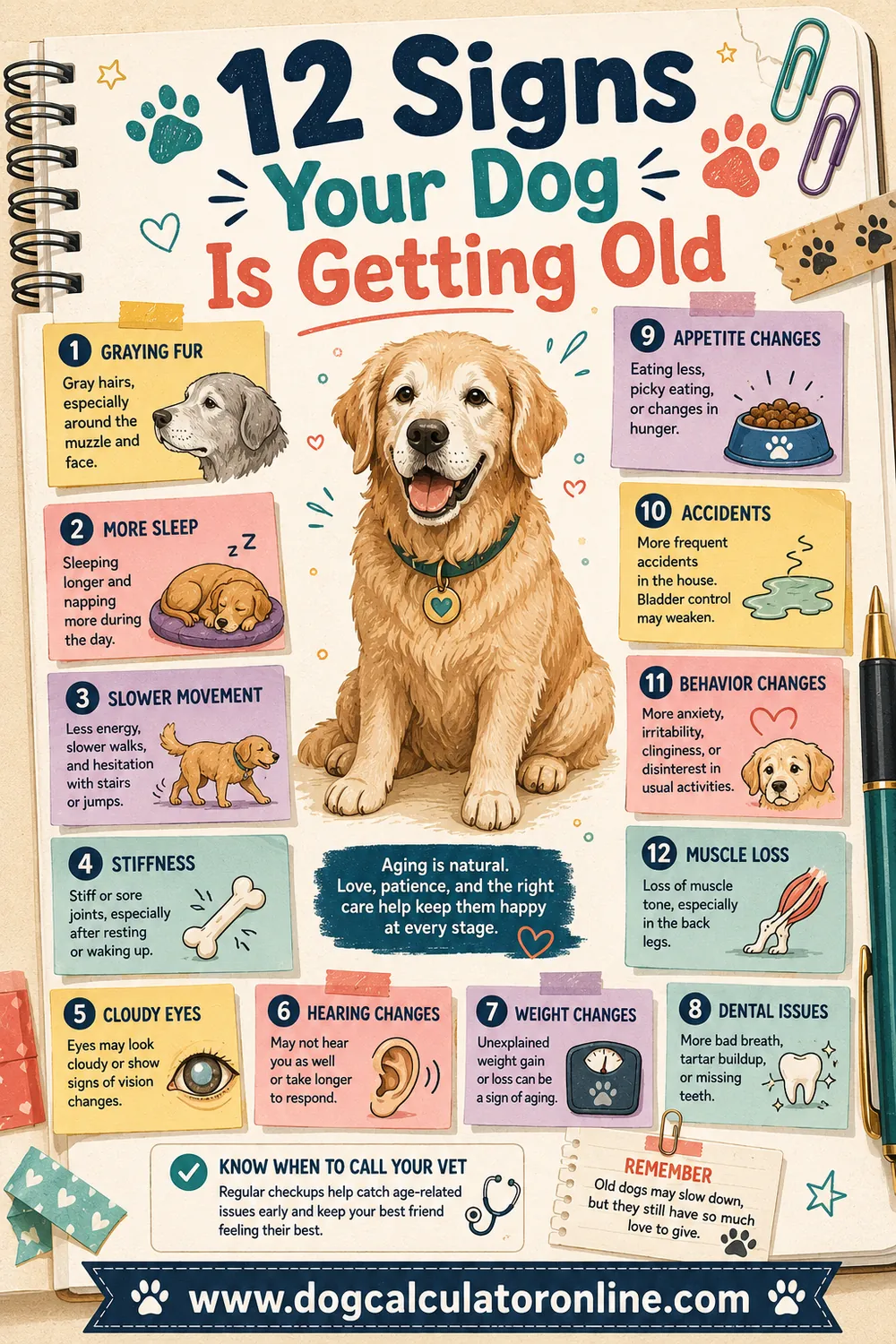
Sleep expands. Senior dogs commonly sleep sixteen to twenty hours a day. Naps get longer and deeper, and your dog may not notice you come home the way she used to. That is normal aging rather than depression.
Movement gets more deliberate. Stairs get considered before they get climbed. Getting up from a lying position takes an extra beat. Jumping onto the couch becomes a decision rather than a reflex. Stiffness is usually worst first thing in the morning and after a long nap, and often eases after a few minutes of walking.
Hearing typically fades before sight. It fades gradually enough that owners frequently read it as stubbornness. A dog who used to come when called and now does not may simply not hear you. High-pitched sounds go first, which is why a clap or a whistle sometimes still works when your voice does not.
The eyes look cloudy. Most dogs over ten develop a bluish haze in the lens called lenticular sclerosis. It is a normal hardening of the lens, it is not painful, and it affects vision far less than it appears to. Cataracts are a different thing, denser and whiter, and worth a professional opinion to tell the two apart.
The muzzle grays and the coat changes. Gray usually starts at the muzzle and eyebrows. Coats can get coarser, thinner or oilier, and the grooming routine may need adjusting.
Habits shift. Some dogs get clingier and follow you from room to room. Some get more solitary and pick a quiet spot. Some develop new anxieties, particularly about being left alone or about noise. All of that sits inside the normal range for this age.
Normal Aging Versus Worth a Vet Visit
The most useful skill at eleven is telling ordinary aging apart from a change that deserves a call. The rough rule is that aging is gradual and symmetrical, while problems tend to be sudden, one-sided, or accompanied by something else changing at the same time.
| What you notice | Usually ordinary aging | Worth calling your vet |
|---|---|---|
| Slowing down | Gradual over months, both sides even | Sudden, limping, or one leg favored |
| Sleeping more | More naps, still alert when awake | Hard to rouse, or pacing at night |
| Drinking | Steady, unchanged habits | Noticeably more, or new accidents indoors |
| Weight | Slow drift with appetite unchanged | Loss without a diet change |
| Breath | Mild, stable | Sharply worse, or dropping food |
| Lumps | Long-standing and unchanged | New, growing, or changing texture |
| Cloudy eyes | Even bluish haze, vision seems fine | Dense white, bumping into things |
That table is a prompt for a conversation, not a diagnosis. Anything in the right-hand column is a question for your vet, who can examine your dog and read her bloodwork, which no chart can do.
These changes are worth a prompt call rather than another week of watching:
- A noticeable change in drinking or urinating
- Weight loss without a diet change
- A new cough, or labored breathing
- A lump that is new, growing, or changing
- Sudden reluctance to use the back legs, or a change in gait
- Loss of appetite lasting more than a day or two
- Any collapse, disorientation, or seizure
None of these necessarily mean something serious. All of them mean the question is better answered by a veterinarian than by the internet.
11 Years Old, Broken Out by Breed
If weighing your dog is inconvenient, here is where familiar breeds land at eleven.
| Breed | Size class | 11 years is about |
|---|---|---|
| Chihuahua | Small | 60 |
| Dachshund | Small | 60 |
| Yorkshire Terrier | Small | 60 |
| Shih Tzu | Small | 60 |
| Pug | Small | 60 |
| Beagle | Medium | 65 |
| Border Collie | Medium | 65 |
| Cocker Spaniel | Medium | 65 |
| French Bulldog | Medium | 65 |
| Australian Shepherd | Medium | 65 |
| Labrador Retriever | Large | 72 |
| Golden Retriever | Large | 72 |
| German Shepherd | Large | 72 |
| Boxer | Large | 72 |
| Doberman | Large | 72 |
| Great Dane | Giant | 86 |
| Saint Bernard | Giant | 86 |
| Newfoundland | Giant | 86 |
| Mastiff | Giant | 86 |
Breed is a shortcut for weight, not an independent factor. A mixed breed goes by the scale, and two Labradors at very different body weights will age slightly differently.
Care Priorities for an 11-Year-Old Dog
Move to twice-yearly vet visits. This is the highest-value change available at eleven. A dog year passes in a couple of human months at this stage, so a great deal can develop between annual exams. Twice-yearly visits with bloodwork and a urine test are the usual senior recommendation, because kidney disease, liver changes, thyroid problems and diabetes show up in lab work long before they show up in behavior.
Take joint pain seriously and never self-medicate. Osteoarthritis is extremely common in senior dogs and is one of the most under-treated conditions in veterinary medicine, largely because dogs hide pain well and owners read slowing down as inevitable. It is not inevitable and it is treatable. Critically, human pain relievers are dangerous to dogs. Ibuprofen, acetaminophen, naproxen and aspirin can all cause serious harm. Any pain management goes through your vet.
Keep her moving, gently. The instinct to let an older dog rest is understandable and mostly wrong. Muscle loss accelerates quickly without use, and weaker muscles mean less joint support, which means more discomfort. Several short walks beat one long one. Swimming and slow leash walks are ideal. Let her set the pace and turn back before she is tired.
Watch her weight closely. Extra weight on aging joints is the most direct thing you can fix at home. Senior dogs burn fewer calories, so the portion that kept her trim at seven may now be too much. Being able to feel her ribs easily without pressing hard is the usual guide.
Take dental disease seriously. By eleven it is close to universal, and it is not just a mouth problem, because chronic oral infection puts real strain on the rest of the body. Breath that has gotten noticeably worse, chewing on one side or dropping food all deserve a mention at the next visit.
Adapt the house before you need to. Rugs or runners on slick floors make an enormous difference to a dog whose back legs are getting weaker. A ramp to the couch or the car saves a jump. Raised bowls help dogs with neck or shoulder stiffness. An orthopedic bed in a warm, draft-free spot matters more than it sounds like it should.
Keep her mentally engaged. Cognitive dysfunction, the canine equivalent of dementia, can show up in senior dogs as nighttime pacing, staring at walls, getting stuck in corners or forgetting house training. Puzzle feeders, short training sessions with cues she already knows, and sniffing walks all give the brain work to do. If you are seeing those signs, mention them, because there are things a vet can do.
Is 11 Old for a Dog?
Yes in every size class, but old is not the same as near the end, and how old depends heavily on what she weighs.
For a small dog, eleven is early senior and comfortably inside a normal lifespan. Many small breeds live to fifteen or sixteen, so an 11-year-old Chihuahua or Yorkshire Terrier may have several good years ahead.
For a medium dog, eleven is a solid senior age with plenty of ordinary life still likely.
For a large dog, eleven is genuinely respectable. Many large breeds average ten to twelve years, so an 11-year-old Labrador or German Shepherd has already reached the upper part of a typical span.
For a giant breed, eleven is rare and remarkable. Great Danes and similar breeds often live seven to ten years, so an 11-year-old giant is an outlier in the best way.
The useful frame at eleven is not counting down. It is noticing sooner: more frequent checkups, quicker responses to small changes, and comfort weighted a little more heavily than it was at six. Most of what makes a senior dog's years good is unglamorous, and it works best when it starts at eleven rather than at fourteen. The 13 dog years page carries the same chart further along if you want to see what comes next.
Frequently Asked Questions
How old is an 11-year-old dog in human years? About 60 for a small dog, 65 for a medium dog, 72 for a large dog and roughly 86 for a giant breed. The old times-seven rule would give 77 for all of them, which is too high for small dogs and too low for giant ones.
Is an 11-year-old dog a senior? Yes, in every size class. Small dogs typically reach senior status around ten or eleven, large dogs closer to seven or eight, and giant breeds as early as six, so by eleven all of them are there.
What changes in an 11-year-old dog's care? The main changes are twice-yearly checkups with bloodwork instead of annual visits, portions adjusted downward as activity drops, exercise shifted toward short and regular rather than long and hard, and small changes at home such as rugs on slick floors and an orthopedic bed. Your vet can tailor that to your dog.
Why does my 11-year-old dog sleep so much and ignore me? Sleeping sixteen to twenty hours a day is normal for a senior dog, and hearing usually fades before sight, so a dog who no longer comes when called may simply not hear you rather than be ignoring you. If the change was sudden, or she seems hard to rouse or disoriented, that is worth a call to your vet.